
Shiba Inu vs. Pepe: Which Meme Coin Holds More Potential in 2025?

Meme coins have become a dominant force in the cryptocurrency space, driven by community support and internet culture. Among them, Shiba Inu (SHIB) and Pepe (PEPE) stand out as two of the most popular and promising contenders. Investors frequently ask: Can PEPE surpass Shiba? Could PEPE coin reach $1? Could SHIB coin reach $1? In this article, we’ll explore the price trends, predictions, and key differences between these two meme coins to determine which holds more potential in 2025.
Shiba Inu (SHIB) Overview: Origin, Utility & Market Performance
Shiba Inu (SHIB) is a decentralized cryptocurrency launched in August 2020 by the anonymous developer "Ryoshi," originally as a meme token but now a major player in the crypto space. Branded as the “Dogecoin Killer,” SHIB gained rapid traction due to its strong community, viral marketing, and expanding ecosystem. Unlike other meme coins, SHIB has developed a solid ecosystem, including:
- ShibaSwap: A decentralized exchange (DEX) that allows SHIB holders to trade and stake their assets.
- Shibarium: A Layer-2 scaling solution that reduces transaction fees and burns SHIB tokens.
- Metaverse Expansion: SHIB is developing its own metaverse project to enhance engagement.
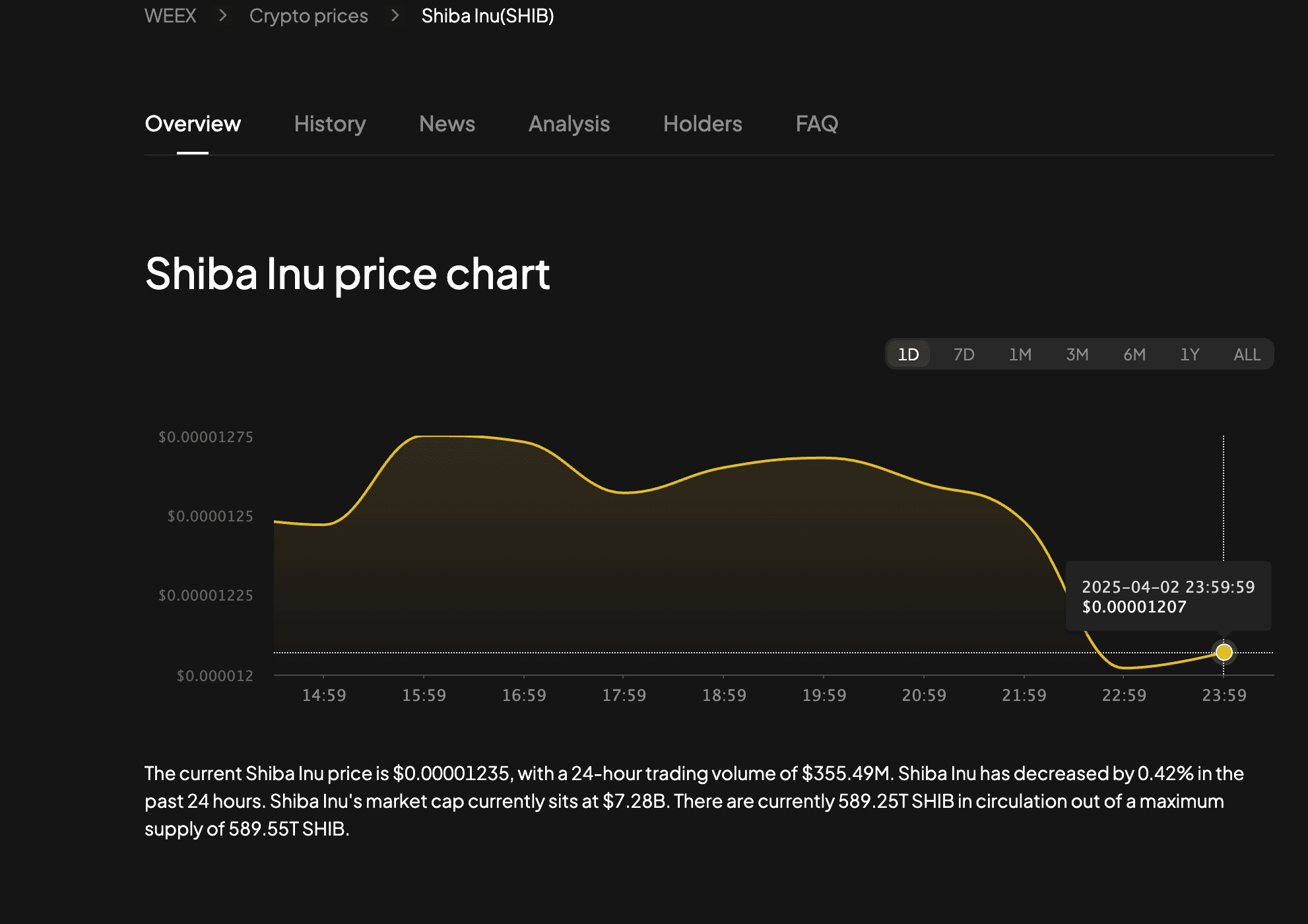
SHIB Market Performance (Early 2025)
- Price: $0.00001239
- Market Cap: $7.3 billion
- 24h Trading Volume: $347 million
- Circulating Supply: 589.25 trillion
- All-Time High: $0.00008616 (October 28, 2021)
Pepe (PEPE) Overview: Growth, Hype & Market Trends
Pepe (PEPE) is a meme-based cryptocurrency inspired by the iconic "Pepe the Frog" and designed to rival popular memecoins like Dogecoin (DOGE) . Launched as an ERC-20 token on the Ethereum blockchain, PEPE thrives on meme culture and social media virality rather than a structured ecosystem. Unlike many speculative tokens, PEPE incorporates a deflationary mechanism, where a small percentage of tokens are burned with each transaction, reducing supply and potentially increasing value over time. Additionally, it features a redistribution system, rewarding existing holders with a portion of transaction fees, encouraging long-term investment. The project's success is largely driven by community engagement, with its team maintaining active communication via social media to fuel adoption and hype.
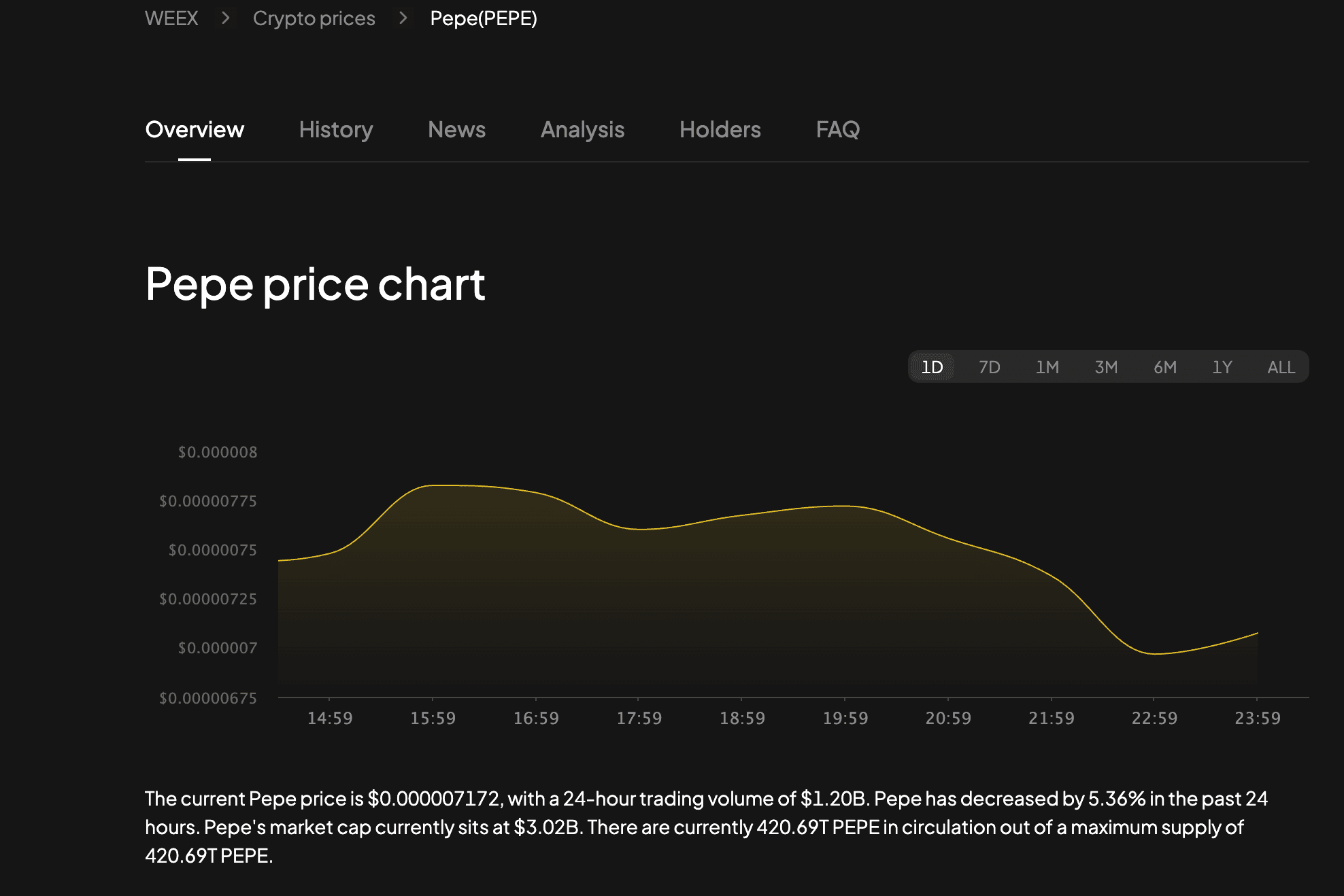
PEPE Market Performance (Early 2025)
- Price: $0.057205
- Market Cap: $3.03 billion
- 24h Trading Volume: $1.3 billion
- Circulating Supply: 420.69 trillion
- All-Time High: $0.00002803 (December 9, 2024)
SHIB Coin Price Prediction: Could SHIB Coin Reach $1?
SHIB Coin Price Prediction for 2025:
- Bearish Scenario: $0.0000075 - $0.000010
- Base Scenario: $0.000015 - $0.000025
- Bullish Scenario: $0.000035 - $0.000050
With a massive circulating supply, SHIB reaching $1 is nearly impossible unless a significant token burn occurs.
Pepe Coin Price Prediction: Could PEPE Coin Reach $1?
PEPE Coin Price Prediction for 2025:
- Bearish Scenario: $0.000010 - $0.000020
- Base Scenario: $0.000025 - $0.000040
- Bullish Scenario: $0.000045 - $0.000080
Despite its rapid growth, PEPE reaching $1 is highly unlikely due to its high supply and speculative nature.

Shiba Inu (SHIB) vs. Pepe (PEPE): Key Comparison & Investment Insights
When comparing Shiba Inu (SHIB) and Pepe (PEPE), several critical factors, including market performance, community support, ecosystem development, and investment potential, come into play.
1. Market Performance & Volatility
- Shiba Inu (SHIB): With a market cap of $7.3 billion and a 24-hour trading volume of $356.28 million, SHIB has demonstrated relative stability. Over the past week, it has gained 2.07%, with a 12.85% increase in the last 24 hours. SHIB also benefits from a deflationary model, where token burns help reduce supply and support price appreciation.
- Pepe (PEPE): Currently holding a $3.03 billion market cap, PEPE boasts a higher trading volume of $1.2 billion, indicating strong liquidity. Over the past 30 days, PEPE has declined 16.59%, but in the past week, it surged 24.87%, reflecting its high volatility. Unlike SHIB, PEPE lacks a structured burn mechanism but benefits from its viral appeal.
2. Community Strength & Sentiment
- Shiba Inu (SHIB): The “Shiba Army” is one of the most engaged communities in crypto space, actively participating in governance, ecosystem expansion, and long-term development. This provides SHIB with consistent support and credibility, making it ideal for long-term holding.
- Pepe (PEPE): While PEPE’s community is smaller, it has seen rapid growth, fueled by internet meme culture and social media trends. However, its success largely depends on virality, making it more suited for short-term speculation rather than long-term stability.
3. Ecosystem & Use Cases
- Shiba Inu (SHIB): SHIB has developed a diverse ecosystem, including:
- ShibaSwap, a decentralized exchange (DEX) for trading and staking SHIB-based assets.
- Shibarium, a Layer-2 scaling solution that reduces gas fees and burns SHIB tokens.
- Metaverse and NFT projects, expanding SHIB’s real-world applications.
- Pepe (PEPE): Unlike SHIB, PEPE lacks a structured ecosystem and primarily thrives on meme-driven speculation. While it has potential for future expansion, its current utility remains limited to its community-driven momentum.
4. Investment Potential & Risks
- Shiba Inu (SHIB): SHIB’s strong ecosystem and active community make it a more stable option for long-term investors. However, due to its large token supply, significant price surges may be challenging.
- Pepe (PEPE): PEPE’s high volatility makes it an attractive choice for short-term traders seeking quick gains. However, its lack of a real-world use case increases investment risk, requiring caution when trading.
SHIB vs PEPE: Which Meme Coin is More Potential?
When comparing Shiba Inu vs. Pepe, SHIB appears to have more long-term potential due to its ecosystem expansion and strong community support. Pepe coin is highly volatile and depends on social media trends, making it riskier for long-term investment.
How to Buy SHIB and PEPE in 2025?
Investing in Shiba Inu (SHIB) or Pepe (PEPE) is a straightforward process. Follow these steps to get started:
- Select a Crypto Exchange – Choose a reliable platform like WEEX that supports SHIB and PEPE trading.
- Create an Account – Sign up on WEEX and complete the KYC verification process to unlock full trading features.
- Deposit Funds – Add funds to your account
- Find SHIB or PEPE – Use the exchange’s search function to locate SHIB/USDT or PEPE/USDT trading pairs.
- Place Your Order – Choose a market or limit order, buy your desired amount, and store it securely in your exchange wallet or a private crypto wallet for added security.
By following these steps, you can seamlessly invest in SHIB and PEPE while taking advantage of market opportunities in 2025.
Conclusion
While Shiba Inu offers more long-term growth potential with its expanding ecosystem, Pepe coin remains a speculative meme-driven asset. Investors should carefully evaluate their risk tolerance before investing in either SHIB coin or PEPE. Could PEPE coin reach $1? Could SHIB coin reach $1? Given their current supply, it's unlikely, but both remain strong contenders in the meme coin market for 2025.
Latest Updates on WEEX
WEEX Exchange’s WXT Token Surges 101%
If you want to buy WXT now, you can sign up for a WEEX account
WEEX Owen: Michael Owen Joins as Global Brand Ambassador
Championing a revolutionary crypto trading experience
You may also like
Can PAC Coin Reach $1 Soon? Analyzing Public Asset Control
PAC is a Solana-based meme token with a government-themed narrative, but it is highly speculative.
At its current price (~$0.0009) and 1B supply, reaching $1 would require a $1B market cap, which is very unlikely.
Short-term moves to $0.001 or $0.01 are more realistic, but the token is highly volatile due to low liquidity and hype-driven trading.
Overall, $1 is not a realistic target, and PAC is better suited for short-term speculation than long-term investment.
NBIS Stock: What Nebius’ AI Cloud Surge Means Now
NBIS stock jumped as Nebius reported rapid AI cloud growth. See the key Q1 2026 numbers, catalysts, valuation risks, and what to watch next.

What Is Public Asset Control (PAC) Coin? Explained for Beginners
Public Asset Control (PAC) is a Solana-based token that uses a “government asset control” narrative involving oil and gold themes, but it has no verified ties to any real institutions or governments. It is mainly an entertainment-focused, speculative meme coin.
The project’s claims about links to entities like BlackRock or Palantir are unverified, and its own disclaimer states it is not a real financial or institutional asset. Like many new Solana tokens, PAC is highly volatile, with low liquidity and limited transparency, including no fully verified audit.
Overall, PAC is a high-risk speculative token driven by hype and storytelling rather than real utility. Beginners are advised to be cautious, verify contract details, and prioritize risk control before considering any trading.

Public Asset Control: What PAC Token Really Is
Public Asset Control PAC is a Solana token with bold asset-control branding. Learn what it is, what is verified, and the key trading risks.

Why Is Chinese Oil Asset Reserve (COAR Crypto) Trending Now?
Why is Chinese Oil Asset Reserve trending now? Learn the latest COAR crypto price action, trading volume, oil narrative, Solana pair data, and what is driving attention today.

How to Buy Chinese Oil Asset Reserve (COAR) Token in 2026: Latest Step-by-Step Guide, Contract Address, and Safe Buying Tips
How to buy Chinese Oil Asset Reserve (COAR) token step by step, including the official COAR contract address, Solana wallet setup, SOL funding, and latest market data.
COAR Coin: What Chinese Oil Asset Reserve Really Is
COAR coin is a new Solana oil-narrative token. Learn what Chinese Oil Asset Reserve claims, how to verify the contract, and key trading risks.

Did the CLARITY Act Pass Today? Latest Status and the History of the Crypto Bill
SEO meta description: Did the CLARITY Act pass today? Read the latest crypto bill update, the history of the CLARITY Act, House and Senate votes, and what happens next for U.S. crypto regulation.
What Is Chinese Oil Asset Reserve (COAR) Token? $COAR and Coar Stock Relationship Explained
Chinese Oil Asset Reserve (COAR) token explained, $COAR price, Solana details, and the relationship between COAR and Coar stock. Learn the latest facts.
Trade to Earn on WEEX: Join the Futures Trading Event and Earn Real-Time WXT Rewards Throughout May 2026
Join the WEEX Trade to Earn Series Five event from May 1–31, 2026 and earn real-time WXT rewards through futures trading. Boost your rebate level, complete missions, invite friends, and maximize your trade to earn rewards with USDT-M futures trading.

Trade to Earn With Futures Trading on WEEX: How Smart Traders Are Turning Every Position Into WXT Rewards
Join the WEEX Trade to Earn Series Five campaign and earn real-time WXT rewards through futures trading from May 1–31, 2026. Upgrade mining levels, unlock higher rebate ratios, complete missions, and maximize your trade to earn rewards with USDT-M futures trading.
CBRS Stock: What to Know About Cerebras After Its IPO
CBRS stock surged after Cerebras priced its IPO at $185. Learn what the AI chipmaker does, why valuation matters, and what risks to watch.

SpaceX IPO Stock Market Impact: What Investors Should Watch
SpaceX’s IPO could reshape indexes, liquidity, space stocks, and crypto risk appetite. Here is what matters before the listing.

HMSTR Token Price: What Moves Hamster Kombat Now
Track HMSTR token price, supply, catalysts, and risks. Learn what drives Hamster Kombat price action and what traders should watch.

How to Buy Public Asset Control (PAC) Token in 2026: Latest Solana Buying Guide
How to buy Public Asset Control (PAC) token in 2026, PAC contract address, Solana wallet setup, Jupiter swap guide, latest price, liquidity, and risks.
What Is Public Asset Control (PAC) Token and How Does It Work? Latest Solana PAC Token Guide
Public Asset Control (PAC) token explained. Learn what PAC is, how it works on Solana, current price snapshot, risks, and buying basics.
What Is WEEX Token (WXT)? A Complete Guide
WEEX Token (WXT) is the native utility token within the WEEX ecosystem. Its main purpose is to improve the trading experience rather than serve purely as a speculative asset.
In simple terms, WXT is mainly used for fee discounts (the more you hold, the lower your trading fees), staking rewards, and participation in platform events and governance voting. It also allows users to engage more deeply in the WEEX ecosystem, including promotional campaigns and future Web3 integrations.
In terms of acquisition, users can typically buy WXT directly on the WEEX exchange using assets like USDT, or earn it through platform events. For storage, it can be kept in an exchange wallet for convenience or transferred to external wallets (such as cold wallets) for enhanced security.
From a tokenomics and market perspective, WXT’s value is closely tied to WEEX’s user growth, trading volume, and overall crypto market conditions, making it relatively volatile and high-risk. Analysts generally view it as more suitable for users interested in the long-term development of the platform rather than short-term speculation.
Overall, WXT is a “trading utility token” that enhances user experience through fee discounts, staking benefits, and eco
What Is OSOR Crypto? Saudi Oil Claim or Scam Risk Explained
OSOR Crypto claims to be the tokenized Official Saudi Oil Reserve. But on-chain data tells a different story. Learn the facts, red flags, and scam risks before you buy.
Can PAC Coin Reach $1 Soon? Analyzing Public Asset Control
PAC is a Solana-based meme token with a government-themed narrative, but it is highly speculative.
At its current price (~$0.0009) and 1B supply, reaching $1 would require a $1B market cap, which is very unlikely.
Short-term moves to $0.001 or $0.01 are more realistic, but the token is highly volatile due to low liquidity and hype-driven trading.
Overall, $1 is not a realistic target, and PAC is better suited for short-term speculation than long-term investment.
NBIS Stock: What Nebius’ AI Cloud Surge Means Now
NBIS stock jumped as Nebius reported rapid AI cloud growth. See the key Q1 2026 numbers, catalysts, valuation risks, and what to watch next.
What Is Public Asset Control (PAC) Coin? Explained for Beginners
Public Asset Control (PAC) is a Solana-based token that uses a “government asset control” narrative involving oil and gold themes, but it has no verified ties to any real institutions or governments. It is mainly an entertainment-focused, speculative meme coin.
The project’s claims about links to entities like BlackRock or Palantir are unverified, and its own disclaimer states it is not a real financial or institutional asset. Like many new Solana tokens, PAC is highly volatile, with low liquidity and limited transparency, including no fully verified audit.
Overall, PAC is a high-risk speculative token driven by hype and storytelling rather than real utility. Beginners are advised to be cautious, verify contract details, and prioritize risk control before considering any trading.
Public Asset Control: What PAC Token Really Is
Public Asset Control PAC is a Solana token with bold asset-control branding. Learn what it is, what is verified, and the key trading risks.
Why Is Chinese Oil Asset Reserve (COAR Crypto) Trending Now?
Why is Chinese Oil Asset Reserve trending now? Learn the latest COAR crypto price action, trading volume, oil narrative, Solana pair data, and what is driving attention today.
How to Buy Chinese Oil Asset Reserve (COAR) Token in 2026: Latest Step-by-Step Guide, Contract Address, and Safe Buying Tips
How to buy Chinese Oil Asset Reserve (COAR) token step by step, including the official COAR contract address, Solana wallet setup, SOL funding, and latest market data.


