
 Buy Crypto
- Markets
 Futures
- Spot
- Copy Trade
- Earn
- More
Why Are We Bullish on Stablecoins as FinTech 4.0?

Key Takeaways:
- FinTech evolution has advanced through multiple stages, leading to the emergence of stablecoins and permissionless finance as the next phase.
- Traditional financial infrastructure has primarily remained unchanged, with new layers focusing on user experience rather than innovation at the core.
- Stablecoins offer a fundamentally new financial architecture that lowers costs and barriers for fintech innovations.
- The key to future success lies in deeply understanding and targeting niche markets rather than general expansion.
WEEX Crypto News, 2026-01-05 07:12:37
In the ever-evolving landscape of financial technology, we stand at the cusp of a revolutionary phase—FinTech 4.0. Reflecting on the last two decades, fintech has undeniably transformed the financial sector, enhancing accessibility to financial products. However, this transformation has largely been one of style over substance, focusing on better interfaces and smoother experiences while core processes have remained largely unchanged. Let’s explore the journey through fintech’s evolutionary stages leading to the rise of stablecoins and the promising potential they hold for the industry.
The Evolution of FinTech: From Interfaces to Infrastructures
FinTech 1.0: Digital Distribution (2000-2010)
The first major wave of fintech, spanning the first decade of the 2000s, was characterized by digitizing financial services. This era saw players like PayPal, E*TRADE, and Mint introducing digital interfaces to existing financial systems. Despite bringing financial services online, these innovations did not fundamentally alter money flow; rather, they changed who could access these services. Operations like fund settlement remained sluggish and mostly manual, indicating the initial digitization was more of a cosmetic overhaul rather than a transformative leap.
FinTech 2.0: The Rise of Neobanks (2010-2020)
With the advent of smartphones, came the emergence of neobanks like Chime and SoFi. These enterprises targeted niche markets with traditional services packaged in contemporary forms, such as wage advances or student loan refinancing. The magnetism of their user-friendly interfaces masked the reality that behind the scenes, these banks relied heavily on existing financial infrastructure. Their success wasn’t due to new payment networks but to their innate marketing and distribution prowess.
FinTech 3.0: Embedded Finance (2020-2024)
Embedded finance emerged as APIs proliferated, enabling software companies to integrate financial products seamlessly. Concepts like Banking-as-a-Service (BaaS) provided new layers through APIs, streamlining the way financial services were embedded across various applications. However, the underlying systems, regulated by legacy banks, remained unchanged. The real shift was not structural but rather operational, from tangible banks to digital APIs.
The Challenges of Traditional FinTech
Despite the remarkable innovations, fundamental constraints have persisted in traditional fintech, dictating the industry’s pace and nature of evolution:
- Monopolized Payment Systems: Dominion by systems such as Visa and Mastercard left little space for disruption.
- Capital-Intensive Startups: Launching finance-heavy products remained capital-heavy, often requiring steep investments.
- Regulatory Restrictions: Tight regulations restricted direct involvement, confining fintech companies to work above a bank-based infrastructure.
These constraints funneled fintech innovations towards product layering on existing systems rather than creating new operational models from the ground up. While fintech firms revolutionized the user interface (UI) and experience (UX), actual financial processes were merely wrapped in sleek packaging tied to bank APIs.
FinTech 4.0: Introducing Stablecoins and Permissionless Finance
Stablecoins herald the dawn of FinTech 4.0, fundamentally altering the architecture by offering a new way of handling financial services. Unlike traditional systems that navigate through intermediaries and involve numerous mandatory fees, stablecoins provide a decentralized structure where financial logic is completely programmable. This shift allows developers to engage with open networks for direct on-chain fund transfers, greatly reducing reliance on banks and archaic systems.
In essence, stablecoins transform the financial industry by replicating core banking functions without the overhead of traditional banks. Instead of rectifying existing systems, they offer an outright alternative, making these structures more cost-effective and agile. The actual transaction volume facilitated by stablecoins now rivals that of monumental networks like Visa and PayPal, verifying their viability.
Why Stablecoins Reshape the Financial Landscape
In a world structured around stablecoins, the entire hierarchy of launching a fintech company transforms radically. No longer does establishing a company entail labyrinthine vendor relationships; rather, it revolves around leveraging decentralized financial infrastructure. Each step, from banking and custody to underwriting and compliance, transitions to on-chain models where transparency and cost-efficiency are key.
Opportunities for Stablecoin-Focused Fintech
The burgeoning arena of stablecoin-infused fintech opens vast opportunities for businesses to serve specified market niches profitably. Previously, traditional fintech companies expanded outward due to pressing demands of high compliance costs and intense customer acquisition strategies. However, stablecoins dissolve these limitations, allowing fintechs to focus on specialized, potentially underserved markets.
Specialized fintech models rooted in stablecoins propose profound implications, such as drastically reduced customer acquisition costs (CAC) and elevated customer lifetime value (LTV). This economic dynamism encourages companies to delve into untapped areas, such as:
- Professional Athletes: Customized financial handling for income concentrated over short sports careers.
- Adult Industry Performers: Bypassing reputational and payout risks with instantaneous, programming-enabled payments.
- Luxury Goods Dealers: Efficient handling of high-value cross-border transactions eliminating lag and risk.
- On-Chain Developers: Streamlined income processing with reduced reliance on conventional banking.
Deep Dive into Specialized Use Cases
New opportunities abound where traditional systems underperform. For instance, adult content creators face arduous banking battles due to reputational risks, relying on intermediaries with exorbitant fees. Here, stablecoins can offer an unassailable solution with instant settlement and self-hosted income processing.
Moreover, professional athletes face singular risks and incomes spread across various regions—making stablecoins an ideal platform to handle scattered payments, taxation, and fund allocation effectively. Countries housing unique financial regulations, like Sharia-compliant markets, could also leverage these innovations, providing tailored solutions aligned with specific tenets.
Overcoming Brand Alignment Challenges with Stablecoins
Introducing stablecoin-driven financial models brings unique brand alignment opportunities and challenges. Companies can redefine their brands by focusing on niche markets unmet by existing players. Rather than spending excessively on broad marketing, these firms can cultivate a loyal user base by deeply understanding and aligning with niche community needs.
Conclusion: The Path Forward
As fintech embraces the stablecoin revolution, the industry is poised for substantial economic reform where small markets can thrive and larger ones operate more efficiently. By redefining financial functionalities, stablecoins reduce overhead costs and redefine traditional user acquisition strategies. The move towards permissionless networks places fintech companies at the helm of financial creativity and innovation.
In this transformative era, the onus is on companies to pivot from mass market appeal to nuanced specialization. As brand positioning in this sector becomes increasingly tied to cultural and operational fluency within targeted communities, fintech companies are uniquely positioned to capitalize on evolving user dynamics, backing their innovation with stablecoin-driven architectures. It’s not simply about reaching the customer. Instead, it’s about truly comprehending and addressing their intricate financial landscapes.
FAQ
What are the key benefits of stablecoins in fintech?
Stablecoins offer significant benefits in fintech, including reduced costs, increased efficiency, and the ability to operate independently of traditional financial networks. They transform financial services by enabling direct, programmable, and transparent transactions without relying on intermediaries.
How do stablecoins change the dynamics of starting a fintech company?
Stablecoins lower the barriers to entry for fintech startups, reducing the initial costs related to compliance and regulatory fees. They allow companies to launch more easily by bypassing complex integrations with older banking systems.
What are some specialized markets that could benefit from stablecoin-based fintech?
Specialized markets such as professional athletes, adult content creators, luxury goods dealers, and those in Sharia-compliant financial spaces stand to gain from stablecoin-based fintech models. These structures offer tailored financial solutions that traditional banking systems often overlook.
Will stablecoins replace traditional banking networks entirely?
While stablecoins present a viable alternative for numerous financial transactions, they are unlikely to completely replace traditional banking networks immediately. Instead, they serve as complementary systems that provide new opportunities and efficiencies for specific use cases.
How will branding transform with the rise of stablecoin-focused fintech?
Branding will become more aligned with niche market needs and cultural dynamics, requiring companies to build deep connections with specific user segments. Understanding and resonating with the target audience will become paramount over broad market appeals.
You may also like

Top 5 Cryptos to Buy in 2026 Q1: A ChatGPT Deep Dive Analysis
Explore the top 5 cryptos to buy in Q1 2026 including BTC, ETH, SOL, TAO, and ONDO. See price outlooks, key narratives, and institutional catalysts shaping the next market move.

How to Earn $15,000 with Idle USDT Before Altcoin Season 2026
Wondering if altcoin season is coming in 2026? Get the latest market update, and learn how to turn your idle stablecoins waiting for entry into extra rewards up to 15,000 USDT.
Can You Win Joker Returns Without Large Trading Volume? 5 Mistakes New Players Make In WEEX Joker Returns Season 2
Can small traders win WEEX Joker Returns 2026 without huge volume? Yes—if you avoid these 5 costly mistakes. Learn how to maximize card draws, use Jokers wisely, and turn small deposits into 15,000 USDT rewards.

Altcoin Season 2026: 4 Stages to Profit (Before the Crowd FOMO In)
Altcoin Season 2026 is starting — discover the 4 key stages of capital rotation (from ETH to PEPE) and how to position before the peak. Learn which tokens will lead each phase and avoid missing the rally.

Will Alt season come in 2026? 5 Tips to Spot the Next 100x Crypto Opportunities
Will altcoin season arrive in 2026? Discover 5 rotation stages, early signals smart traders watch, and the key crypto sectors where the next 100x altcoin opportunities may emerge.

The bear market has arrived, and cryptocurrency ETF issuers are also getting involved

The richest man had a quarrel with his former boss

BTC Firm Above 70K! Saylor’s "Institutional Logic" vs. Moon’s "Retail Faith": Who is Really Harvesting the Market?
Bitcoin is holding firm above the $70,000 support level following a massive short squeeze that liquidated $427 million. As the "Four-Year Cycle" narrative shifts, the market is split: Michael Saylor’s cold, institutional "indiscriminate stacking" vs. Carl Moon’s high-energy retail "hopium." This article decodes these two polar-opposite strategies for the 2026 bull run and reveals how WEEX’s institutional-grade liquidity and AI trading tools empower every type of investor to convert market volatility into profit.

The Girl Who Created the SBTI Test: A Story of a Doomed Cyber Love, an E-Widow Ratfolk

B.AI Officially Launched: Building AI Agent Financial Bedrock Platform, Driving AGI Era Business Underlying Logic

B.AI Officially Launched: Breaking Down A2A Collaboration Barriers to Unlock the Smart Body Economy's Full Potential
We helped Xu Mingxing write a book called "<OK Life>".

Rare APY of 400%, is TradeXYZ handing out money to oil bulls?
a16z: Perpetual Contracts are Rewriting Global Trading Rules
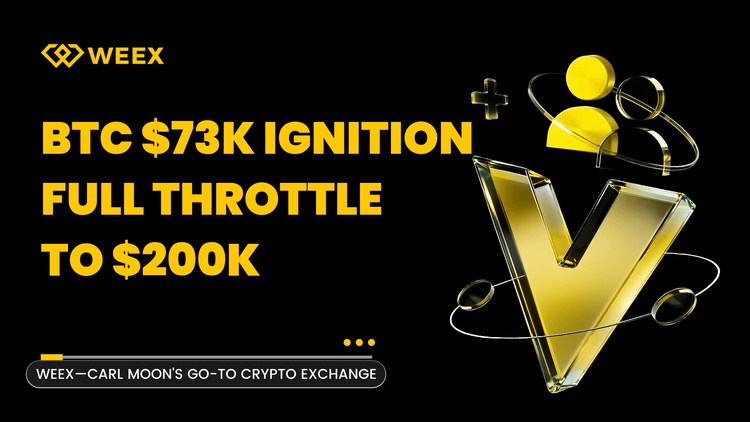
Bitcoin Hits $73,000 Triggering $427M Short Liquidation | Carl Moon: $200,000 is the Target
April 9, 2026 (UTC+0), 22:17. Bitcoin (BTC) executed a high-velocity surge within minutes, heavy-hitting the $73,000 psychological barrier and touching a local high near $74,000. While the price has since retraced to consolidate above $72,000, this "instant ambush" successfully completed a $427M liquidation of short positions.

a16z partner: perpetual contracts are rewriting the global trading rules

Bitcoin ETF Inflows Just Turned Positive After 5 Months of Outflows: What Does That Mean for BTC Price Now?
The Hidden Risks Behind Bitcoin ETF Inflows in 2026: What Traders Should Know. The question now isn't whether inflows are happening. It's what they're telling you about the next phase and whether your portfolio is positioned for it.
Decoding 2026's Bitcoin ETF Data: How to Trade Alongside Institutional Smart Money in 2026
After months of sustained outflows, rolling 30-day net ETF inflows just crossed 30,000 BTC. That's not noise. Historically, when institutional capital rotates back in at this scale, it marks a regime shift — not just a bounce.
Top 5 Cryptos to Buy in 2026 Q1: A ChatGPT Deep Dive Analysis
Explore the top 5 cryptos to buy in Q1 2026 including BTC, ETH, SOL, TAO, and ONDO. See price outlooks, key narratives, and institutional catalysts shaping the next market move.
How to Earn $15,000 with Idle USDT Before Altcoin Season 2026
Wondering if altcoin season is coming in 2026? Get the latest market update, and learn how to turn your idle stablecoins waiting for entry into extra rewards up to 15,000 USDT.
Can You Win Joker Returns Without Large Trading Volume? 5 Mistakes New Players Make In WEEX Joker Returns Season 2
Can small traders win WEEX Joker Returns 2026 without huge volume? Yes—if you avoid these 5 costly mistakes. Learn how to maximize card draws, use Jokers wisely, and turn small deposits into 15,000 USDT rewards.
Altcoin Season 2026: 4 Stages to Profit (Before the Crowd FOMO In)
Altcoin Season 2026 is starting — discover the 4 key stages of capital rotation (from ETH to PEPE) and how to position before the peak. Learn which tokens will lead each phase and avoid missing the rally.
Will Alt season come in 2026? 5 Tips to Spot the Next 100x Crypto Opportunities
Will altcoin season arrive in 2026? Discover 5 rotation stages, early signals smart traders watch, and the key crypto sectors where the next 100x altcoin opportunities may emerge.


 App
App