
Unveiling Funding Rate Arbitrage: How Institutions 'Earn While Sleeping' and Retail Traders 'See But Can't Touch'?


Original Title: "Unveiling Funding Rate Arbitrage: How Institutions 'Earn While Lying Down' and Retail Investors 'See But Can't Get'?"
Original Source: 4Alpha Research
1. Basic Concept and Principle of Funding Rate: The Crypto World's 'Balancing Tax' and 'Red Envelope' Mechanism
1.1 What Is a Perpetual Contract?
In the financial market, arbitrage opportunities between the spot and futures markets are not uncommon, with participants ranging from large hedge funds to individual investors. However, in the crypto market's 24/7 trading environment, a special derivative has emerged — the perpetual contract.
Key Difference Between Perpetual Contracts and Traditional Futures Contracts:
· No Delivery Date: Perpetual contracts have no delivery date, allowing users to hold positions long-term as long as their margin remains sufficient and they do not get liquidated.
· Funding Rate Mechanism: The contract price is anchored to the spot price through the funding rate, ensuring that the contract price remains aligned with the spot index price in the long run.
In terms of pricing mechanism, perpetual contracts use a dual-price mechanism:
· Mark Price: Used to calculate liquidation conditions, it is determined by the weighted average spot price from multiple exchanges to prevent manipulation by a single platform.
· Real-Time Trading Price: The actual trading price in the market that determines users' entry cost.
Through the funding rate mechanism, perpetual contracts can maintain long-term market equilibrium without a delivery date.
1.2 What Is a Funding Rate
The funding rate is a mechanism in perpetual contracts used to adjust the market's long and short forces, with its core purpose being to keep the contract price as close to the spot price as possible.
In specific calculation terms, the funding rate consists of a premium part and a fixed part, where the premium refers to the deviation between the contract's real-time trading price and the spot index price.
· Premium Rate = (Contract Price - Spot Index Price) / Spot Index Price
· Funding Rate = Base Rate set by the trading platform
When the funding rate is positive, it indicates that the contract price is higher than the spot price, the long position market is too strong, and long positions need to pay the funding rate to shorts, suppressing excessive optimism in the long positions.
When the funding rate is negative, the opposite is true. Shorts need to pay fees to longs, suppressing excessive pessimism in shorts.
Funding Rate Settlement Period: Generally settled every 8 hours, meaning that users holding contracts within each settlement period need to pay or receive the funding rate.
1.3 How to Understand the Funding Rate Mechanism of Perpetual Contracts in Layman's Terms
The funding rate mechanism of perpetual contracts can be likened to the rental housing market:
· Tenant (Long) = Investor buying perpetual contracts
· Landlord (Short) = Investor shorting perpetual contracts
· Area Average Price (Mark Price) = Spot market average price
· Rental Actual Price (Contract Real-time Price) = Market transaction price of the perpetual contract
Example:
If there are too many tenants (longs) causing the rent (contract price) to be driven up above the market average price (mark price), then tenants need to pay a red packet (funding rate) to landlords to bring the rent down.
If there are too many landlords (shorts) causing the rent to be pushed down, then landlords need to pay a red packet to tenants to push the rent up.
Essentially, the funding rate is a dynamic equilibrium adjustment tax in the market, used to punish the party that disrupts market balance and reward the party that corrects market balance.
2. Funding Rate Arbitrage Strategy: Three Methods with a Common Source of Income
2.1 Financial Explanation of Funding Rate Arbitrage
The core of funding rate arbitrage lies in: locking in funding rate gains through hedging spot and contract positions while avoiding price volatility risks. Its basic logic includes:
· Rate Direction Judgment: Based on long and short forces, significant arbitrage opportunities exist when the funding rate deviates significantly.
· Risk Hedging: Offset price volatility risks through inverse positions in spot and contracts, only earning the funding rate.
· High-Frequency Compounding: Settlement occurs every 8 hours, with a significant compounding effect.
Essentially, Funding Rate Arbitrage is a Delta-Neutral Strategy, which involves locking in a specific yield factor (funding rate) without taking on price direction risk.
2.2 Three Methods of Funding Rate Arbitrage
1) Single-Coin Single-Exchange Platform Arbitrage (Most Common)
Specific operational steps:
a. Determine Direction: If the funding rate is positive, meaning longs pay fees, it is suitable to short the futures contract and long the spot.
b. Establish Positions: Short the perpetual contract + Long the spot
c. Collect Rate: Assuming the underlying spot price rises, the short position in the combination incurs losses, offset by the gains in the two, but the long position in the futures contract needs to pay you the funding rate, earning you the funding rate revenue.
2) Single-Coin Cross-Exchange Platform Arbitrage
Specific operational steps:
a. Scan Exchange Platform Funding Rates: Choose two exchanges with sufficient liquidity and significant differences in funding rates
b. Establish Positions: Short the perpetual contract (Exchange A) + Long the perpetual contract (Exchange B)
c. Earn Funding Rate Difference: Profit from the difference in funding rates based on the exchange's varying rates
3) Multi-Coin Arbitrage
Specific operational steps:
a. Select Highly Correlated Coins: Meaning coins with highly correlated trends, utilize funding rate differentials, hedge direction through position combinations, and earn returns.
b. Establish Positions: Short the high funding rate coin (such as BTC) + Long the low funding rate coin (such as ETH), adjust positions based on the ratio
c. Earn Returns: Funding rate difference + Volatility gains
In the above three methods, the difficulty increases sequentially. In practical applications, the first method is the most common. The second and third methods require high requirements and technical difficulty in terms of execution efficiency and transaction latency. Leveraged arbitrage can also be added on top of the above, but this requires higher risk control and comes with increased risk.
Furthermore, on the basis of funding rate arbitrage, there are more advanced practices that combine spread arbitrage and basis arbitrage to enhance returns and improve capital efficiency. Spread arbitrage refers to arbitrage opportunities using the price difference of the same underlying asset on different trading platforms (spot and perpetual contracts). When the market is highly volatile or liquidity is unevenly distributed, funding rate arbitrage can be combined with spread arbitrage to further increase the strategy's yield. Basis arbitrage involves exploiting the price difference between perpetual contracts and traditional futures contracts. The funding rate of perpetual contracts changes with market sentiment, while traditional futures contracts are settlement contracts, creating a certain price difference relationship.
In summary, regardless of the hedging arbitrage method used, complete risk hedging against price fluctuations must be achieved; otherwise, returns will be eroded. Additionally, costs such as transaction fees, borrowing costs (for leverage operations), slippage, margin requirements, etc., must also be considered. As the overall market matures, the returns from simple strategies will diminish. To sustain profitability, algorithmic monitoring, cross-platform arbitrage, and dynamic position management need to be combined. More advanced arbitrage strategies combined with spread arbitrage require high trading execution efficiency and market monitoring capabilities, making them suitable for institutional investors or quantitative trading teams with a certain level of technical expertise and risk management systems.
3. Institutional Advantage: Why Can Retail Traders "See but Not Eat"? What Is the Reason?
While funding rate arbitrage seems logically simple, in practice, institutions have established a significant advantage through technological barriers, economies of scale, and systematic risk management.
3.1 Opportunity Identification Dimension: A Down-to-Earth Blow on Speed and Breadth
Institutions use algorithms to monitor real-time funding rates, liquidity, correlations, and other parameters across tens of thousands of assets in the market, identifying arbitrage opportunities in milliseconds.
Retail traders rely on manual processes or third-party tools (such as Glassnode), which can only cover hourly lagging data and focus on a few mainstream assets.
3.2 Opportunity Capture Efficiency: The Cost Gap Between Technology and Trading Volume Disparities
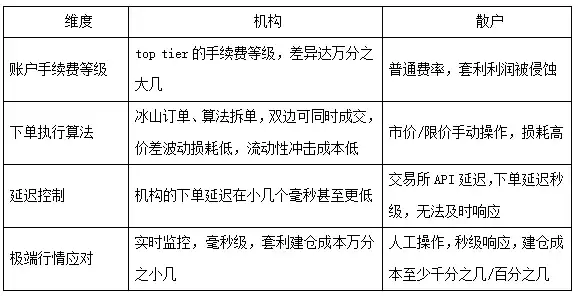
Due to significant advantages in their overall technical infrastructure and cost control, institutions and retail traders may see a yield gap in arbitrage income that could be several times higher.
3.3 Risk Management System: Systematic Risk Response and Human Gameplay
From the perspective of overall risk control, institutions have a mature system for managing position risk, which allows them to act promptly in extreme situations. They can selectively reduce positions, add margin, and take other measures to mitigate risk. In contrast, retail investors tend to respond slowly and have limited tools to deal with extreme conditions. The main differences are as follows:
a. Response Speed: Institutional response speed is at the millisecond level, while individuals operate at the second level at best. When not closely monitored, response times can even stretch to minutes or hours, making it difficult to ensure a rapid response.
b. Risk Control Precision: Institutions can accurately calculate and adjust positions for specific assets or add margin to a reasonable level, dynamically managing their risk exposure. On the other hand, individual investors lack the ability to make precise calculations and adjustments, often resorting to market liquidation.
c. Handling Multiple Assets: When risk events occur, institutions can concurrently manage positions in dozens or even hundreds of assets, minimizing the impact on each asset. In contrast, individual investors can only handle assets sequentially, processing a limited number of assets in a single-threaded manner.
4. Outlook for Arbitrage Strategies and Investor Adaptation
4.1 Institutional Arbitrage Strategy Differences and Market Capacity Limit
Many people wonder if the market can support the widespread adoption of arbitrage strategies by institutions and whether this would dampen returns. In reality, there is a noticeable degree of "sameness" in the logic of institutional strategies.
· Sameness: Within the same type of strategy, such as arbitrage, the strategic approach is generally similar across institutions.
· Difference: Each institution has its own strategic preferences and unique advantages. Some institutions focus on large-cap assets, uncovering opportunities in these assets, while others prefer smaller assets and excel in asset rotation.
Moreover, concerning the market's capacity limit, arbitrage strategies represent the highest capacity stable income strategy in the market, contingent on overall market liquidity. A rough estimate suggests that the current arbitrage capacity exceeds tens of billions. However, this capacity is not fixed but rather dynamically balanced with liquidity growth, strategy evolution, and market maturity, especially with the rapid expansion of crypto derivative platforms, which will expand the entire arbitrage space.
While there is competition among institutions, the slight differences in strategy, asset coverage, and technical understanding mean that, given the current capacity, returns are not significantly affected.
4.2 Investor Adaptation
Arbitrage strategies, with a mature risk management system, typically carry minimal risk and rarely experience drawdowns. For investors, the main trade-off is the opportunity cost of relative returns: during periods of subdued market trading, arbitrage strategies may yield low returns over an extended period, while during bullish markets, the explosive returns are usually lower than trend-following strategies. Hence, arbitrage strategies are relatively more suitable for conservative investors.
From the perspective of advantages, low volatility and drawdown, making it a safe haven during bear markets, more favored by risk-averse and conservative funds, such as family offices, insurance funds, mutual funds, and high-net-worth individual wealth allocation.
From the perspective of disadvantages, the profit ceiling is not as high as trend-following strategies, with arbitrage strategies averaging 15%-50% annualized return; lower than the profit ceiling of long-only strategies/trend-following strategies (theoretically can be 1x to several times).
For ordinary retail investors, personal arbitrage practice is an investment with "low returns + high learning costs," with an unfavorable risk-reward ratio. It is more advisable to participate indirectly through institutional asset management products.
Funding rate arbitrage is the "deterministic return" of the crypto market, but the gap between retail investors and institutions lies not in cognition but in the disadvantages of "technology, cost, and risk control" being too obvious. Instead of blindly imitating, it is better to choose transparent and compliant institutional arbitrage products and use them as a "ballast" for asset allocation.
You may also like

Why Is Bitcoin Down in 2026? What We Can Learn From 2022
The large models in the United States are moving towards closure in the name of security
From the white-haired stock god to the billionaire fund mogul, the smart people shorting Nvidia are all getting rich using the same framework
Morning Report | CoinEx becomes a key hub for Iran to evade sanctions, involving over $3.8 billion in funds; Kalshi seeks a new round of financing, with a valuation potentially rising to $40 billion
Global Launch: As predictions become the most scarce asset in the AI era, Manadia is defining the next generation of the value internet
Why do cryptocurrency projects always like to change their names?
Who is footing the bill for the $64 billion accounting frenzy?
I never expected that the first application of AI x Crypto would be in security auditing
What is your view on Binance's competitive advantages?
ETH has entered a non-consensus phase, and the turning point is approaching!
The shift in the cloud of the air: from despising stablecoins a year ago to the high-profile entry of capital today
The survival dilemma of small and medium exchanges behind the withdrawal anomalies exposed by AscendEX
Why Is Bitcoin Falling Below $60K? 5 Key Market Drivers Explained
Bitcoin has dropped sharply amid ETF outflows, Strategy stock weakness, AI stock rallies, and changing Fed expectations. Explore the key forces driving BTC’s latest correction and what traders should watch next.
Bitcoin vs. Gold in 2026: Which Asset Performs Better in Different Markets?
The cryptocurrency industry has entered the "Show Me" era: merely relying on vision is no longer enough
Morning News | The draft amendment to the People's Bank of China Law aims to clarify the legal status of digital renminbi; South Korea will transfer about 40 unregistered virtual asset service providers to law enforcement agencies
Interpreting the Ethereum Foundation's new structure: Reaffirming self-sovereignty amid institutional trends
Former SpaceX engineer reconstructs the financial execution system using first principles
Why Is Bitcoin Down in 2026? What We Can Learn From 2022
The large models in the United States are moving towards closure in the name of security
From the white-haired stock god to the billionaire fund mogul, the smart people shorting Nvidia are all getting rich using the same framework
Morning Report | CoinEx becomes a key hub for Iran to evade sanctions, involving over $3.8 billion in funds; Kalshi seeks a new round of financing, with a valuation potentially rising to $40 billion
Global Launch: As predictions become the most scarce asset in the AI era, Manadia is defining the next generation of the value internet
Why do cryptocurrency projects always like to change their names?


