
Top VC Heavyweights Back $28 Million Endorsement, All You Need to Know About Former Solana Foundation Core Member's New Project Double Zero


The market has recently experienced significant volatility, with sentiment plunging into extreme fear. However, just a few days ago, the DoubleZero Foundation announced that it had secured a $28 million investment led by Dragonfly and Multicoin Capital. This news quickly caught the attention of many. What makes DoubleZero unique and able to attract capital in the current bleak market environment?
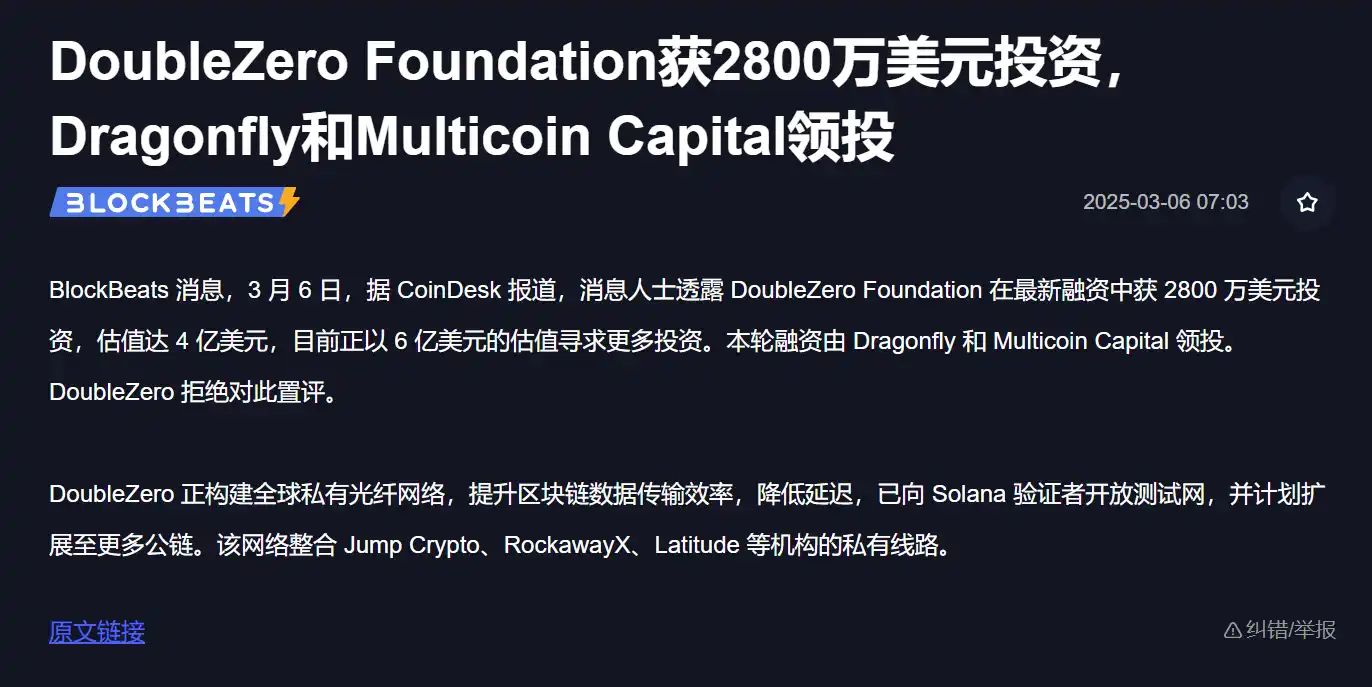
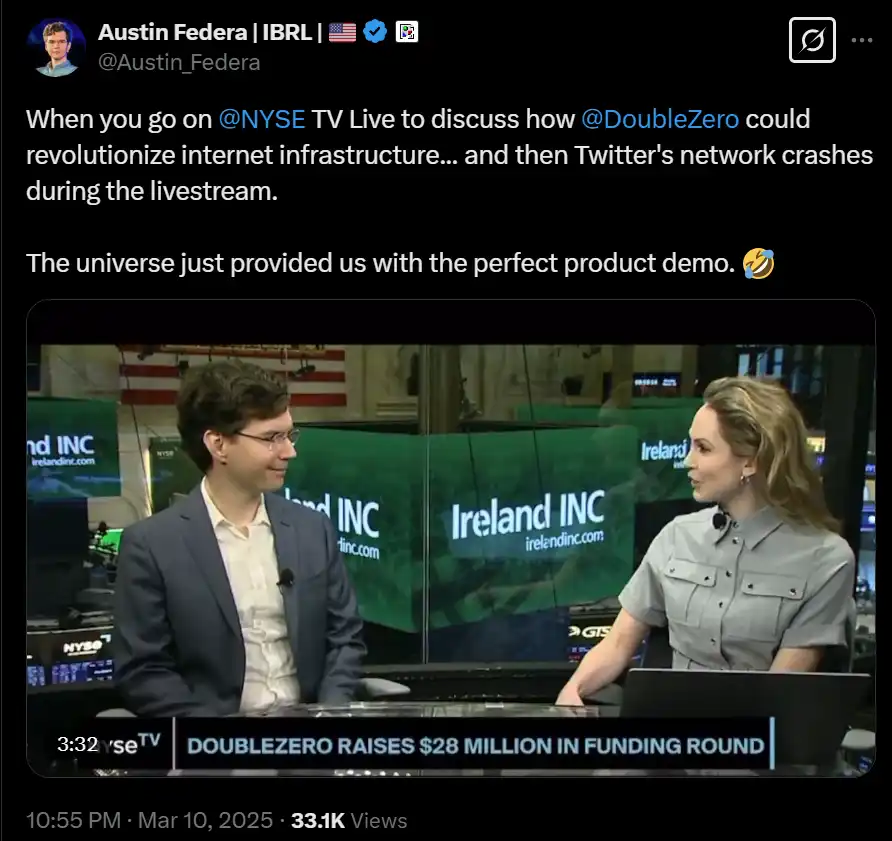
Just yesterday, DoubleZero's founder, Austin Federa, appeared on a live TV show at the New York Stock Exchange (NYSE) to discuss how DoubleZero is innovating internet infrastructure. Interestingly, Twitter went down during the live broadcast.
In a tweet, he joked that it was like the universe's "perfect product demo" for them. This tweet carried a hint of sarcasm, implying that the current internet infrastructure does have bottlenecks, and DoubleZero might be the solution.
DoubleZero: The Dark Horse of DePIN
DoubleZero is a project based on the DePIN track, allowing anyone to contribute independently licensed fiber optic links. It's like laying down an "information superhighway" for the Web3 world. The project's key highlight is its hardware-driven nature, focusing directly on the infrastructure layer. DoubleZero's goal is simple: to enhance bandwidth and reduce latency for all high-performance blockchains.
The project quickly attracted industry attention with its unique technical vision and the highly reputable background of its team, seen as a significant narrative within the Solana ecosystem and the DePIN space.
Solana's "Veteran" Austin Federa Leads the Way, Bringing DoubleZero's Halo Effect
For a project to stand out from the crowd, it needs not only technical prowess but also a core figure who can mobilize resources and drive the narrative. One reason DoubleZero immediately captured the market's attention upon its debut is its CEO and founder—Austin Federa.
Those familiar with the Solana ecosystem will undoubtedly recognize him. He previously served as the Head of Strategy at the Solana Foundation, playing a crucial role in the early rise of the Solana ecosystem. With deep ties to the Solana core team (including Anatoly Yakovenko and Raj Gokal), this relationship allowed DoubleZero to obtain early support and market recognition within the Solana ecosystem.
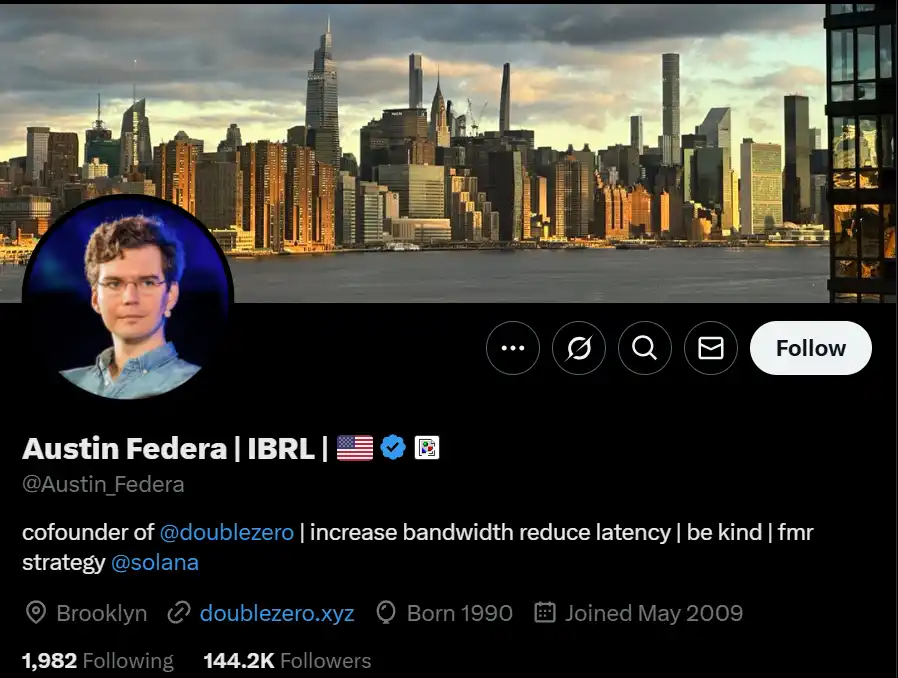
During his time at the Solana Foundation, he was not only responsible for global market strategy, but also directly involved in the implementation of several key projects, such as driving the integration of USDC and USDT on Solana, and even deeply involved in the FTX era ecosystem partnership. In other words, as Solana was able to grow from an emerging public chain to an industry giant, Austin played a key role.
And now, with his experience, connections, and deep understanding of blockchain, Austin has stepped out of Solana to personally lead Double Zero. This not only positioned Double Zero at a higher starting point from the beginning, but also instantly raised market expectations for this project.
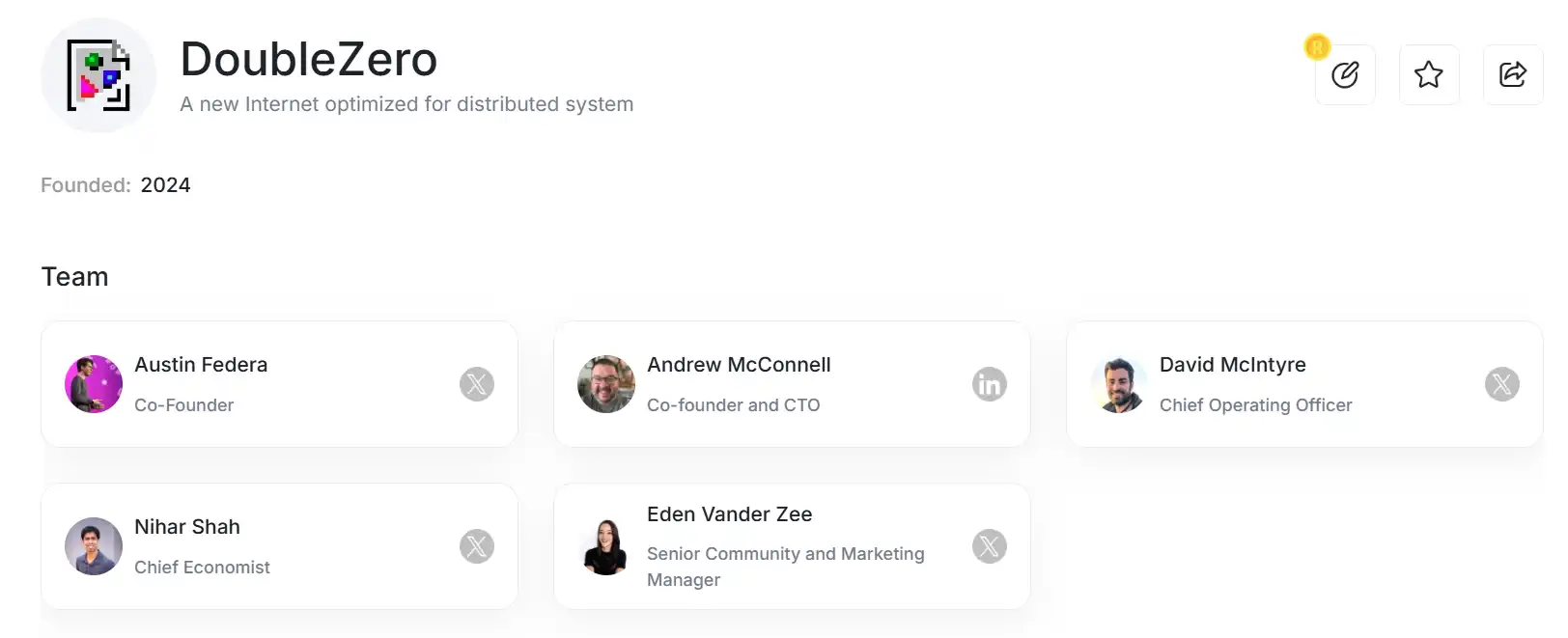
From a technological vision perspective, Double Zero and Solana also share a lineage, with some even considering Double Zero as an important piece of the Solana DePIN narrative. Rather than seeing Double Zero as an independent DePIN project, it is more like Solana's "field upgrade" in the DePIN area.
Rising Star in the Capital Market
If you are familiar with the investment landscape of the crypto community, you will know the significant influence of Dragonfly and Multicoin. They are not only long-term supporters of the Solana ecosystem, but have also played key roles in several projects (for example, Multicoin's early bet on Solana, Dragonfly's involvement in Serum).
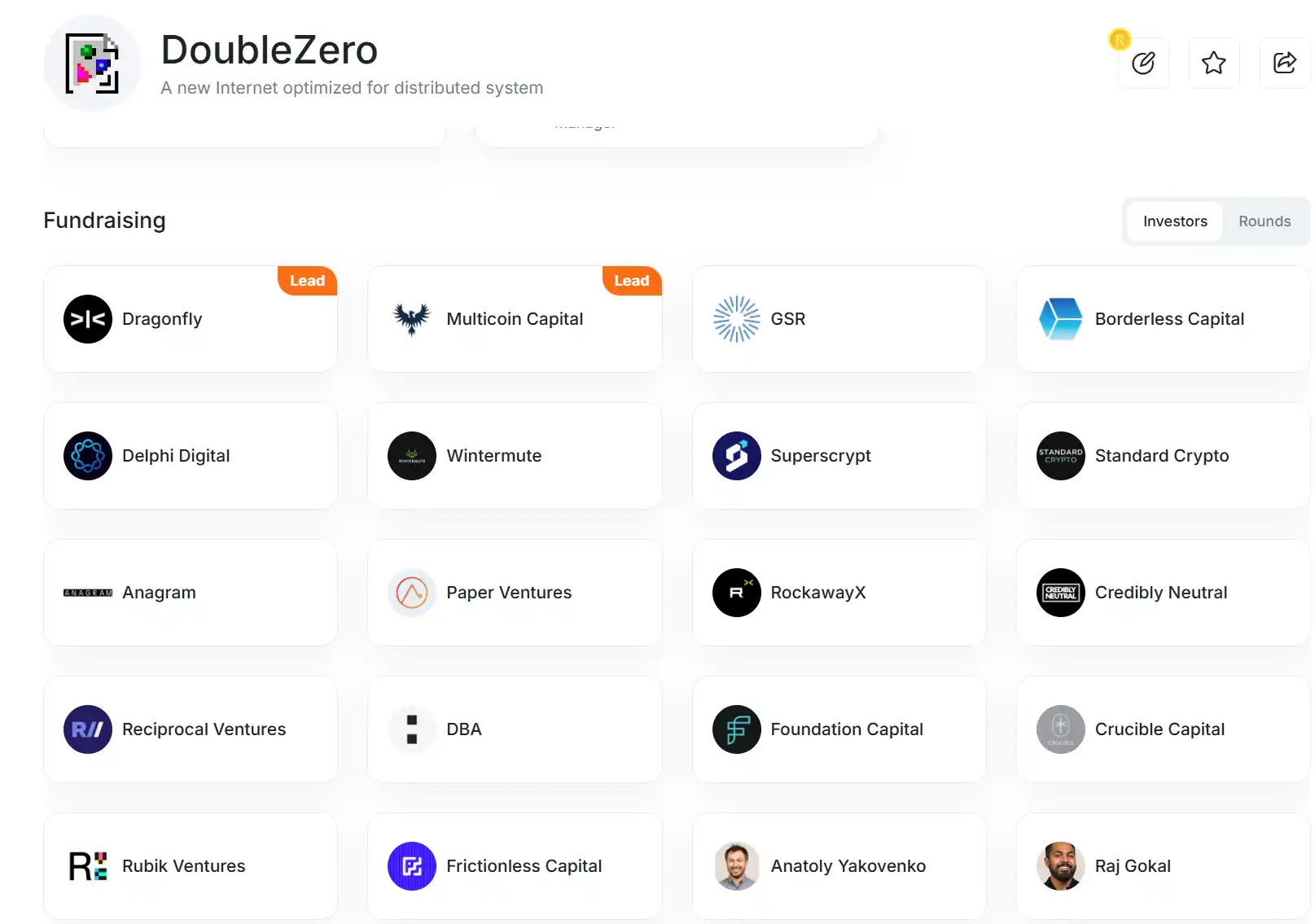
In addition to top VCs, the internal funding power within the Solana ecosystem also played a core role in this round of financing. Solana Ventures and Solana Labs co-founders Anatoly Yakovenko and Raj Gokal also participated as angel investors, what does this mean?
Solana officially stepped in to show support, and Austin is not fighting alone, but entering with the entire pool of Solana's resources, a comprehensive tilt of funds, technology, and market resources. For the entire DePIN track, this is undoubtedly an important signal: the Solana ecosystem is actively laying out the physical infrastructure network, and Double Zero may be the "vanguard" leading the charge.
Technical Highlight: Is Double-Ring Architecture a Super Accelerator?
The DoubleZero Network has optimized the blockchain system through two key enhancements: first, it pre-filters incoming spam and duplicate transactions using dedicated hardware, reducing the burden on validators and allowing the blockchain to share filtering resources without each validator having to provide them individually. Second, it has improved communication efficiency through explicit message routing, tracking, and priority management.
The Outer Ring connects to the public internet, using hardware (such as FPGA) for attack protection, signature verification, and transaction filtering; the Inner Ring, on the other hand, processes this filtered traffic through dedicated bandwidth lines and performs consensus building.
The core technical highlight of Double Zero lies in its unique Double-Ring Architecture. The Outer Ring connects to the public internet and uses hardware (such as FPGA) for attack protection, signature verification, and transaction filtering, while the Inner Ring processes this filtered traffic through dedicated bandwidth lines and performs consensus building.
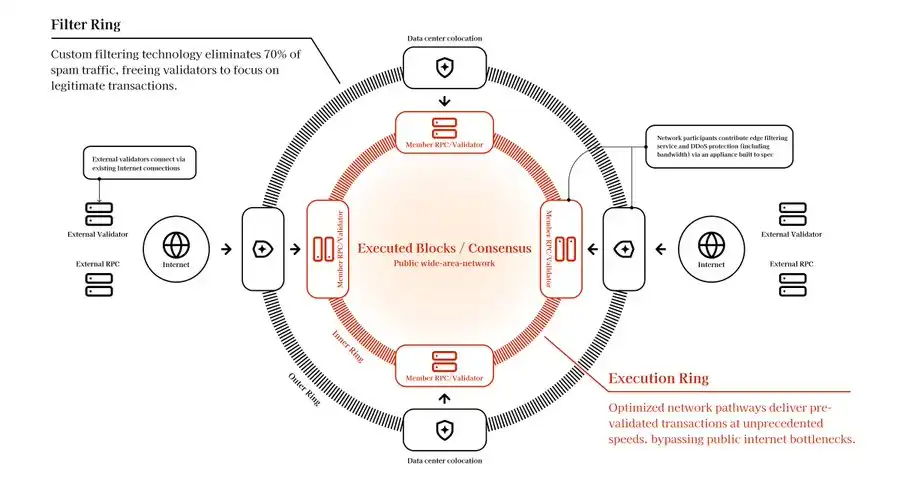
The Outer Ring acts as the first line of defense, primarily responsible for filtering out spam transactions, DDoS attacks, and malicious contract invocations, among other invalid traffic. Through an adaptive traffic filtering mechanism, it utilizes machine learning and heuristic rules to analyze transaction patterns in real-time, accurately identify and intercept malicious traffic, ensuring that only valid transactions can enter the blockchain mainnet.
Additionally, the Outer Ring relies on decentralized zero-permission fiber contributions, where independent contributors from the network provide physical infrastructure, further ensuring the authenticity and priority of data packets. All transactions must undergo basic validity checks by the Outer Ring before entering the Inner Ring, reducing the entry of invalid transactions into the core network and enhancing overall processing efficiency.
Transactions entering the Inner Ring have undergone strict screening, allowing it to focus on efficient transaction processing. The Inner Ring adopts a high-performance architecture similar to Solana, supporting ultrahigh TPS (transactions per second) to ensure extremely short transaction confirmation times, capable of meeting the demands of a large number of transactions.
To further enhance network smoothness, Double Zero also employs a stateless validation model. This lightweight transaction processing method, compared to the traditional blockchain state storage model, enables the entire network to operate more smoothly and efficiently.
Advantages Compared to Traditional Layer 1 and Rollup Solutions
Compared to traditional Layer 1 and Rollup solutions, Double Zero has demonstrated significant advantages. First, through the Outer Ring's front-running filtering, Double Zero effectively reduces the impact of spam transactions, lowers the risk of block congestion, and avoids the inefficient Mempool queuing method seen in public chains like Ethereum. Unlike the Rollup approach, Double Zero independently optimizes the network layer, eliminating the need for batch processing wait times, significantly speeding up transaction confirmation times, and avoiding unnecessary delays.
As Kyle Samani, Managing Partner at Multicoin Capital, puts it: "Due to public internet bandwidth limitations and non-deterministic routing, without addressing the latency issue among validators, achieving a smooth Web2-like experience is not possible." This is precisely the mission of Double Zero.
You may also like

Why Is PAXG Price Different From Gold? 5 Reasons Crypto Traders Should Know

The cryptocurrency industry has entered the "Show Me" era: merely relying on vision is no longer enough

WEEX OpenAPI 101: 5 Powerful Modules, AI Trading Tools, and Grab Up to 70% Revenue Opportunities
Learn how WEEX OpenAPI connects traders, developers, AI agents, and trading platforms. Discover WEEX API features, Binance-compatible integration, automated trading workflows, revenue opportunities, and ecosystem possibilities.

Morning News | The draft amendment to the People's Bank of China Law aims to clarify the legal status of digital renminbi; South Korea will transfer about 40 unregistered virtual asset service providers to law enforcement agencies

Interpreting the Ethereum Foundation's new structure: Reaffirming self-sovereignty amid institutional trends

Interview with NDV Founder Jason Huang: Popping the AI Bubble and the Myth of Microstrategy, Seeking the Ultimate Ace in the Crypto Market
Morning Report | Former Ethereum Foundation researcher establishes Ethlabs; EU Parliament Economic Committee passes digital euro regulatory proposal

Dragonfly partner Haseeb: The fastest-growing companies in the future may all be stuck at 149 people

How xBubble Breaks the Deadlock in VC's Heavy Investment in the OPC Economy

The encrypted unicorn Blockstream is deeply embroiled in a serious fraud case

Morning Report | The South Korean Financial Services Commission plans to expand the regulatory sandbox to include virtual assets; the parent company of the New York Stock Exchange, ICE, has reached a partnership with OKX to jointly establish a cryptocu...

Exclusive Interview with Strategy CEO: Putting Aside the Sale of 32 BTC, the 60 Trillion AI Intelligence is the Ultimate Fate of Bitcoin

TRON revitalizes the image of the bull, creating a more approachable brand character

Will the STRC issuance price discussed with ChatGPT really fall into a death spiral?

The foundation retreats, Ethlabs steps forward: Ethereum welcomes its largest restructuring in history

NYSE Parent ICE and OKX Launch Joint Venture: What It Means for Tokenized Stocks
ICE and OKX have announced a joint venture focused on tokenized stocks, but stock futures are already live across crypto markets. Here's what the partnership means, how stock futures work, and why traders are paying attention.

How to Trade Apple and Nvidia on a Crypto Exchange in 2026 (Without Buying Shares)
Morning Report | Secret Network loses $4.67 million due to cross-chain vulnerability; Michael Saylor releases Bitcoin Tracker information again, may disclose increased holdings data next week
Why Is PAXG Price Different From Gold? 5 Reasons Crypto Traders Should Know
The cryptocurrency industry has entered the "Show Me" era: merely relying on vision is no longer enough
WEEX OpenAPI 101: 5 Powerful Modules, AI Trading Tools, and Grab Up to 70% Revenue Opportunities
Learn how WEEX OpenAPI connects traders, developers, AI agents, and trading platforms. Discover WEEX API features, Binance-compatible integration, automated trading workflows, revenue opportunities, and ecosystem possibilities.
Morning News | The draft amendment to the People's Bank of China Law aims to clarify the legal status of digital renminbi; South Korea will transfer about 40 unregistered virtual asset service providers to law enforcement agencies
Interpreting the Ethereum Foundation's new structure: Reaffirming self-sovereignty amid institutional trends
Interview with NDV Founder Jason Huang: Popping the AI Bubble and the Myth of Microstrategy, Seeking the Ultimate Ace in the Crypto Market


