
 Buy Crypto
- Markets
 Futures
- Spot
- Copy Trade
- Earn
- More
The Fed's hawkish rate cut: BTC lost the 100,000 mark, and the total market value of cryptocurrencies plummeted by 7.5%

Original title: "After the Fed's hawkish rate cut, the overall cryptocurrency market has ushered in a correction"
Original author: Alvis, MarsBit
At the latest Fed interest rate meeting last night, the benchmark policy rate was lowered by 25 basis points to a range of 4.25%-4.5%. Although this result was in line with market expectations, the hawkish wording in the statement and the adjustment of economic forecasts had a profound impact on market sentiment, and the overall cryptocurrency market suffered a sharp correction. The prices of mainstream and altcoins such as Bitcoin, Ethereum, Dogecoin and Solana have all fallen significantly.
The Fed sent a hawkish signal, causing market fluctuations
Federal Reserve Chairman Jerome Powell made it clear at the press conference that although the rate cut was in line with market expectations, the frequency and magnitude of future rate cuts may be much lower than the previous market assumptions. Powell stressed that the Fed only plans to cut interest rates twice in 2025, and also raised its inflation forecast for 2025 from 2.1% to 2.5%. This adjustment reflects the Fed's deep concern about future inflationary pressures.
Powell specifically mentioned the uncertainty of future economic policies, including the protectionist policies that the incoming Trump administration may implement, such as tariffs on imported goods, large-scale deportation of undocumented workers, and the possible expansion of fiscal deficits, as important reasons for the Fed to maintain a more cautious attitude. These potential policy changes may further exacerbate inflationary pressures and have a wide impact on the market.
Bitcoin led the decline, and the crypto market was under pressure
The price of Bitcoin quickly fell 5.6% to $100,000 after the Fed announced the rate cut, and it has recovered as of press time.
Ethereum fell even more significantly, down 6.96% to $3,600. Altcoins such as Dogecoin and Solana were not immune, with Solana down more than 7% and Dogecoin, hit by high volatility, down more than 8%. The broader altcoin market has been particularly bleak, with some second- and third-tier assets falling more than 10%.
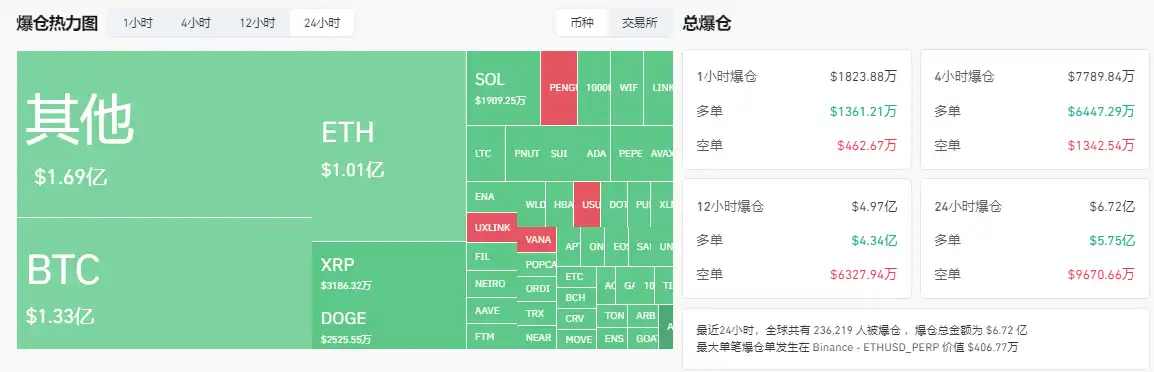
According to Coinglass data, a total of 236,199 people worldwide were liquidated in the last 24 hours, with a total liquidation amount of $672 million, and the largest single liquidation occurred on Binance - ETHUSD_PERP worth $4.0677 million.

Cryptocurrency analyst Skew pointed out that the rapid decline of Bitcoin cleared the long and short positions in the market, indicating that the market has entered a deep adjustment period. The price of Bitcoin once fell to the key bidding range of $100,000 to $98,000. Analysts believe that if the support level of $100,000 to $101,400 cannot be regained before the daily close, the market may continue to look for a new bottom.
Economic forecasts highlight inflation risks, and dot plots show policy determination
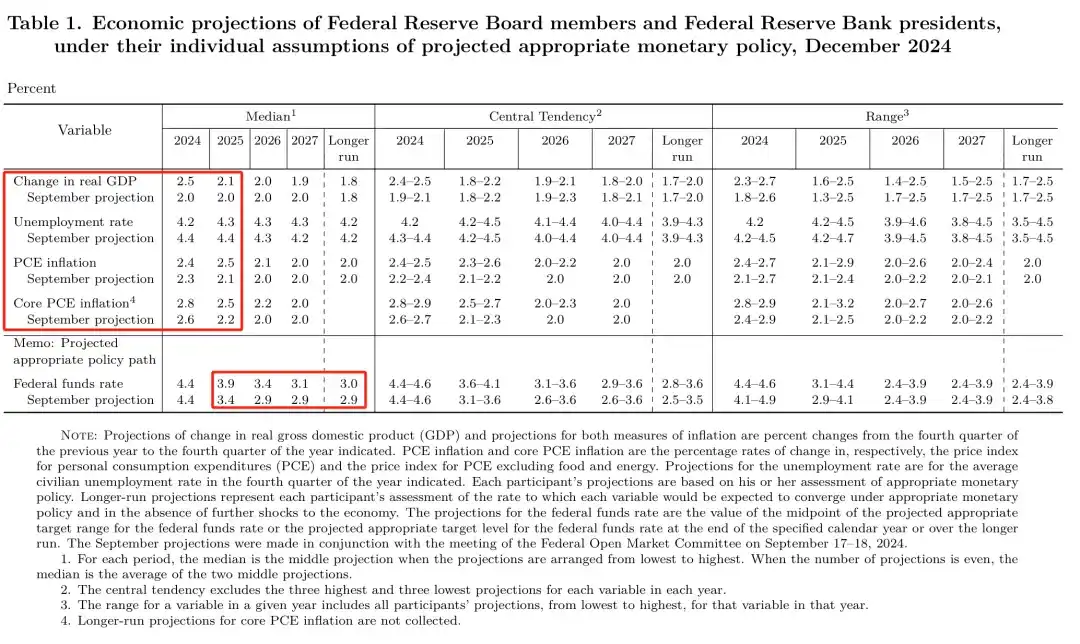
The economic forecasts in this meeting clearly show the Fed's policy considerations. The Fed raised its economic growth forecasts for 2024 and 2025, while lowering its unemployment forecasts and significantly raising its inflation forecasts. In particular, the upward adjustment of the inflation forecast for 2025 is large, showing that the Fed attaches great importance to the long-term inflation risk.
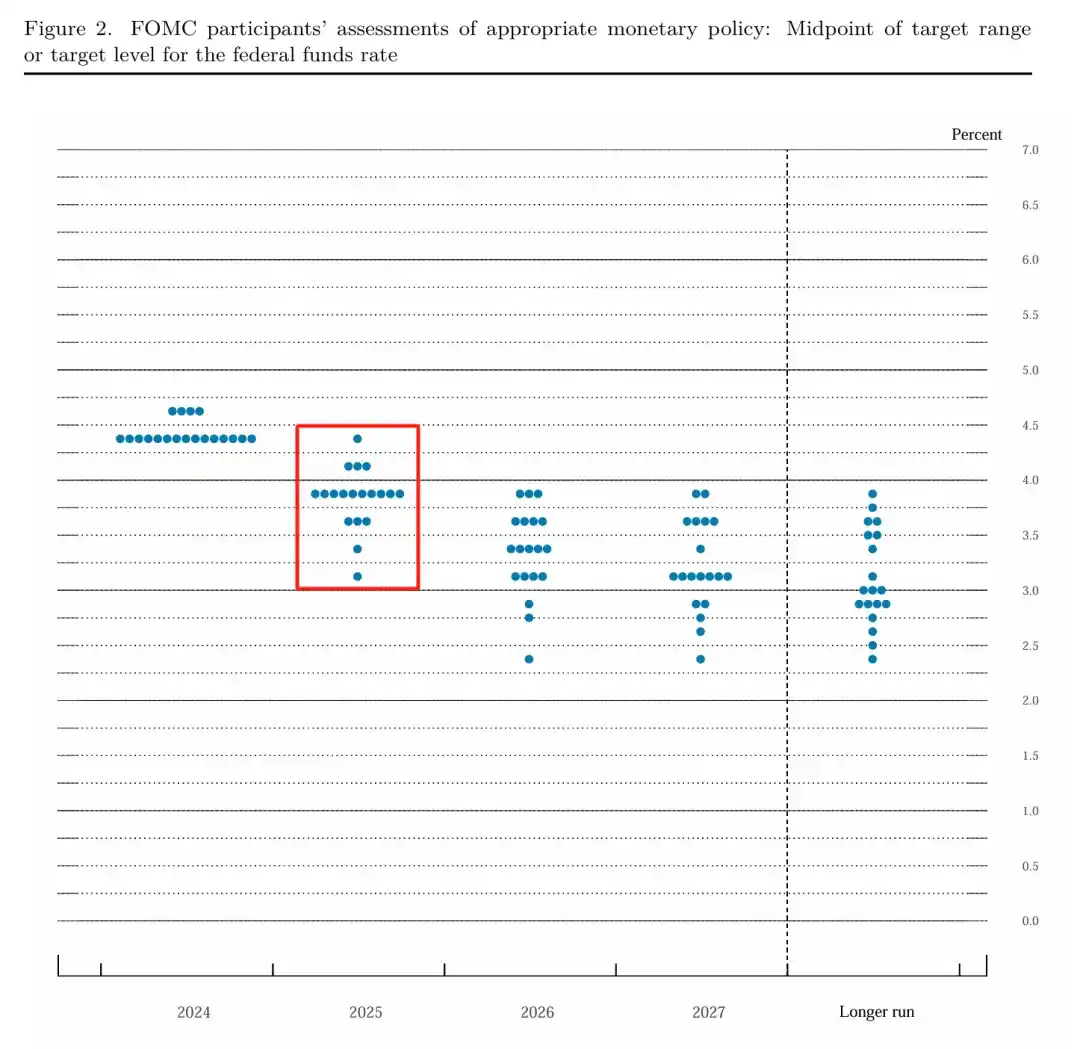
The dot plot shows that the Fed may only cut interest rates twice in 2024. This cautious policy attitude not only shows its firm determination to control inflation, but also makes the market reassess the future liquidity environment. The US dollar and the volatility index (VIX) rose sharply due to this signal, while US Treasury yields, US stocks, gold and cryptocurrency markets were generally under pressure.
Short-term outlook: The crypto market faces continued adjustments
Against this macro background, the cryptocurrency market may continue to be under pressure in the short term. Whether mainstream assets such as Bitcoin and Ethereum can hold key support levels will have an important impact on market confidence. At the same time, altcoins such as Solana and Dogecoin may perform more dramatically because these assets usually show higher sensitivity to market fluctuations.
Powell mentioned the uncertainty of the economic outlook many times in the press conference and reiterated that future policy adjustments will be based on data. Against the backdrop of a complex global macro environment, investors need to carefully evaluate the allocation strategy of crypto assets and pay close attention to the upcoming economic data to determine the medium- and long-term trends of the market.
Despite the current low market sentiment, analysts generally believe that this round of adjustments also provides patient long-term investors with opportunities for strategic layout. The price correction of mainstream crypto assets may lay the foundation for future increases, and some altcoins that have been wrongly killed may usher in a higher rebound space when the market recovers.
Attached is the original text of Powell's statement:
Recent indicators suggest that economic activity continues to expand at a solid pace. Labor market conditions have generally eased since the beginning of the year, and the unemployment rate has increased somewhat but remains low. Inflation has moved toward the Committee's 2 percent objective but remains slightly elevated.
The Committee seeks to achieve maximum employment and 2 percent inflation over the longer term. The Committee judges that risks to achieving its employment and inflation objectives are roughly balanced. The economic outlook is uncertain, and the Committee is mindful of two-way risks to its dual mandate.
To support its objectives, the Committee decided to lower the target range for the federal funds rate by 25 basis points to 4-1/2 to 4-1/2 percent. The Committee will carefully assess incoming data, the evolving outlook, and the balance of risks as it considers the size and timing of further adjustments to the target range for the federal funds rate. The Committee will continue to reduce its holdings of Treasury securities, agency debt, and agency mortgage-backed securities. The Committee is strongly committed to supporting maximum employment and returning inflation to its 2 percent objective.
In assessing the appropriate stance of monetary policy, the Committee will continue to monitor the implications of incoming information for the economic outlook. The Committee will be prepared to adjust the stance of monetary policy, as appropriate, if risks emerge that could impede the achievement of the Committee's goals. The Committee's assessment will take into account a wide range of information, including its readings on labor market conditions, inflation pressures and inflation expectations, and financial and international developments.
Voting in favor of the monetary policy action were: Chairman Jerome Powell, Vice Chairman John Williams, Thomas Barkin, Michael Barr, Raphael Bostic, Michelle Bowman, Lisa Cook, Mary Daly, Philip Jefferson, Adrienne Kugler, and Christopher Waller. Beth M. Hammack dissented in favor of maintaining the target range for the federal funds rate at 4.5 to 4.75 percent.
You may also like

From x402 to MPP: Cloudflare's crucial vote, will it go to Coinbase or Stripe?

BlackRock CEO issues annual open letter: The wave of tokenization has arrived, and we will lead this trend

When Backpack backstabs the community

When gold is no longer a safe haven, and Bitcoin continues to panic

Trump, the World's Largest Oil Trader

If the US and Iran have not reached an agreement in 5 days, what other cards does Trump have?

Tether Whale Dumps £12 Million, Backing Crypto’s ‘British Trump’
Ethereum Foundation Post: Rethinking the Division of Work Between L1 and L2 to Build the Ultimate Ethereum Ecosystem

Two Major Prediction Market Platforms Unite Rarely, What Is the Story Behind This New Fund?
Dragonfly Partners: Most agents will not engage in autonomous trading, how can crypto payments prevail?

US AI Startup Goes All In on Chinese Mega-Model | Rewire News Morning Brief

Trump Lies Again: A "Five-Day Pause" Psyop, How Wall Street, Bitcoin, and Polymarket Insiders Synced Uposciogen

When a Token Becomes Labor, People Become the Interface

Ceasefire News Leaked Ahead of Time? Large Polymarket Bets on Outcome Before Trump's Tweet
BlackRock CEO's Annual Shareholder Letter: How is Wall Street Using AI to Keep Profiting from National Pension Funds?

Sun Valley Releases 2025 Financial Report: Bitcoin Mining Revenue Reaches $670 Million, Accelerating Transformation to AI Infrastructure Platform
On March 16, 2026, in Dallas, Texas, USA, CanGu Company (New York Stock Exchange code: CANG, hereinafter referred to as "CanGu" or the "Company") today announced its unaudited financial performance for the fourth quarter and full year ended December 31, 2025. As a btc-42">bitcoin mining enterprise relying on a globally operated layout and dedicated to building an integrated energy and AI computing power platform, CanGu is actively advancing its business transformation and infrastructure development.
• Financial Performance:
Total revenue for the full year 2025 was $688.1 million, with $179.5 million in the fourth quarter.
Bitcoin mining business revenue for the full year was $675.5 million, with $172.4 million in the fourth quarter.
Full-year adjusted EBITDA was $24.5 million, while the fourth quarter was -$156.3 million.
• Mining Operations and Costs:
A total of 6,594.6 bitcoins were mined throughout the year, averaging 18.07 bitcoins per day; of which 1,718.3 bitcoins were mined in the fourth quarter, averaging 18.68 bitcoins per day.
The average mining cost for the full year (excluding miner depreciation) was $79,707 per bitcoin, and for the fourth quarter, it was $84,552;
The all-in sustaining costs were $97,272 and $106,251 per bitcoin, respectively.
As of the end of December 2025, the company has cumulatively produced 7,528.4 bitcoins since entering the bitcoin mining business.
• Strategic Progress:
The company has completed the termination of the American Depositary Receipt (ADR) program and transitioned to a direct listing on the NYSE to enhance information transparency and align with its strategic direction, with a long-term goal of expanding its investor base.
CEO Paul Yu stated: "2025 marked the company's first full year as a bitcoin mining enterprise, characterized by rapid execution and structural reshaping. We completed a comprehensive adjustment of our asset system and established a globally distributed mining network. Additionally, the company introduced a new management team, further strengthening our capabilities and competitive advantage in the digital asset and energy infrastructure space. The completion of the NYSE direct listing and USD pricing also signifies our transformation into a global AI infrastructure company."
"As we enter 2026, the company will continue to optimize its balance sheet structure and enhance operational efficiency and cost resilience through adjustments to the miner portfolio. At the same time, we are advancing our strategic transformation into an AI infrastructure provider. Leveraging EcoHash, we will utilize our capabilities in scalable computing power and energy networks to provide cost-effective AI inference solutions. The relevant site transformations and product development are progressing simultaneously, and the company is well-positioned to sustain its execution in the new phase."
The company's Chief Financial Officer, Michael Zhang, stated: "By 2025, the company is expected to achieve significant revenue growth through its scaled mining operations. Despite recording a net loss of $452.8 million from ongoing operations, mainly due to one-time transformation costs and market-driven fair value adjustments, the company, from a financial perspective, will reduce its leverage, optimize its Bitcoin reserve strategy and liquidity management, introduce new capital to strengthen its financial position, and seize investment opportunities in high-potential areas such as AI infrastructure while navigating market volatility."
The total revenue for the fourth quarter was $1.795 billion. Of this, the Bitcoin mining business contributed $1.724 billion in revenue, generating 1,718.3 Bitcoins during the quarter. Revenue from the international automobile trading business was $4.8 million.
The total operating costs and expenses for the fourth quarter amounted to $4.56 billion, primarily attributed to expenses related to the Bitcoin mining business, as well as impairment of mining machines and fair value losses on Bitcoin collateral receivables.
This includes:
· Cost of Revenue (excluding depreciation): $1.553 billion
· Cost of Revenue (depreciation): $38.1 million
· Operating Expenses: $9.9 million (including related-party expenses of $1.1 million)
· Mining Machine Impairment Loss: $81.4 million
· Fair Value Loss on Bitcoin Collateral Receivables: $171.4 million
The operating loss for the fourth quarter was $276.6 million, a significant increase from a loss of $0.7 million in the same period of 2024, primarily due to the downward trend in Bitcoin prices.
The net loss from ongoing operations was $285 million, compared to a net profit of $2.4 million in the same period last year.
The adjusted EBITDA was -$156.3 million, compared to $2.4 million in the same period last year.
The total revenue for the full year was $6.881 billion. Of this, the revenue from the Bitcoin mining business was $6.755 billion, with a total output of 6,594.6 Bitcoins for the year. Revenue from the international automobile trading business was $9.8 million.
The total annual operating costs and expenses amount to $1.1 billion.
Specifically, they include:
· Revenue Cost (excluding depreciation): $543.3 million
· Revenue Cost (depreciation): $116.6 million
· Operating Expenses: $28.9 million (including related-party expenses of $1.1 million)
· Miner Impairment Loss: $338.3 million
· Bitcoin Collateral Receivable Fair Value Change Loss: $96.5 million
The full-year operating loss is $437.1 million. The continuing operations net loss is $452.8 million, while in 2024, there was a net profit of $4.8 million.
The 2025 non-GAAP adjusted net profit is $24.5 million (compared to $5.7 million in 2024). This measure does not include share-based compensation expenses; refer to "Use of Non-GAAP Financial Measures" for details.
As of December 31, 2025, the company's key assets and liabilities are as follows:
· Cash and Cash Equivalents: $41.2 million
· Bitcoin Collateral Receivable (Non-current, related party): $663.0 million
· Miner Net Value: $248.7 million
· Long-Term Debt (related party): $557.6 million
In February 2026, the company sold 4,451 bitcoins and repaid a portion of related-party long-term debt to reduce financial leverage and optimize the asset-liability structure.
As per the stock repurchase plan disclosed on March 13, 2025, as of December 31, 2025, the company had repurchased a total of 890,155 shares of Class A common stock for approximately $1.2 million.

The US AI Startup Is Loving China's Open Source Model



 App
App