
 Buy Crypto
- Markets
 Futures
- Spot
- Copy Trade
- Earn
- More
Resigned in Less Than a Year of Taking Office, Why Did Yet Another Key Figure at the Ethereum Foundation Depart?

Original Title: "Another Personnel Change at EF? Ethereum Guard: Getting Used to It"
Original Author: bootly, via BitpushNews
The Ethereum Foundation (EF) once again finds itself at a crossroads of personnel turbulence.
Ethereum Foundation Co-Executive Director Tomasz Stańczak announced his resignation, to take place at the end of this month. This comes only 11 months after he and Hsiao-Wei Wang took over the long-standing leadership from Aya Miyaguchi in March last year to form a new core leadership.

He will be succeeded by Bastian Aue. This individual has very limited public information, with an X account registration of only eight months and almost no speaking records. He will continue to co-lead this organization that controls the core resources and direction of the Ethereum ecosystem along with Hsiao-Wei Wang.
This seemingly sudden personnel change is actually the inevitable result of internal conflicts, external pressures, and strategic shifts within the Ethereum Foundation.
A Trial by Fire: A Turbulent Year
To understand Stańczak's resignation, one must first look back to the context of his tenure.
In early 2025, the Ethereum community was in a state of anxiety. At that time, following the U.S. presidential election, the cryptocurrency market was generally bullish, with Bitcoin hitting new highs repeatedly, competitive chains like Solana gaining momentum, and Ethereum's price performance relatively weak, with the Ethereum Foundation itself coming under fire.
The criticisms were squarely aimed at the then-Executive Director Aya Miyaguchi. The developer community complained of a serious disconnect between the Foundation and frontline builders, conflicts of interest in strategic direction, and insufficient effort in promoting Ethereum. Some questioned the Foundation's overly "laissez-faire" approach, accusing it of adopting a gentle stance as a "facilitator" rather than a "leader," causing Ethereum to lose its first-mover advantage.
As the "mother of Ethereum," the Foundation was asked to act not through inaction, but through assertive measures.
Amid this public opinion storm, Miyaguchi stepped back and joined the board. Stańczak and Wang were thrust into the spotlight to take on the challenge.
Stańczak was not a parachutist. He is the founder of Nethermind, a company that is one of Ethereum's core ecosystem client implementations, playing a key role in infrastructure development. He understands the technology, has entrepreneurial experience, and has a firsthand understanding of community pain points.
In his own words, the instructions he received at the beginning of his tenure were very clear: "The community is shouting — you are too chaotic, you need to be more centralized, speed up a bit, in order to deal with this critical period."
What has been done this year?
The Stańczak and Wang duo did bring about visible changes.
First is organizational efficiency. The Foundation laid off 19 employees, streamlined its structure, and tried to shed its bureaucratic label. The strategic focus shifted from Layer 2 back to Layer 1 itself, making it clear that scaling the Ethereum mainnet is a priority, rather than letting L2s go their own way. The upgrade pace noticeably accelerated, with EIPs being pushed forward more decisively than before.
Second is a posture adjustment. The Foundation began releasing a series of videos on social media, proactively explaining Ethereum's technical roadmap and development direction to the public. This "going out" communication approach contrasts with the relatively closed, mysterious image of the past.
In terms of strategic layout, Stańczak drove exploration in several new directions: privacy protection, addressing the threat of quantum computing, and the integration of artificial intelligence with Ethereum. Especially in the AI direction, he clearly stated that he sees the trends of "agent systems" and "AI-assisted discovery" reshaping the world.
On the financial front, the Foundation began discussing a more transparent budget management and fund allocation strategy, attempting to respond to external questions about the efficiency of treasury use.
Vitalik Buterin's assessment of Stańczak was: "He has greatly improved the efficiency of multiple departments within the Foundation, making this organization more responsive to the external world."
Implications in the Resignation Statement
Not even a year, why leave?
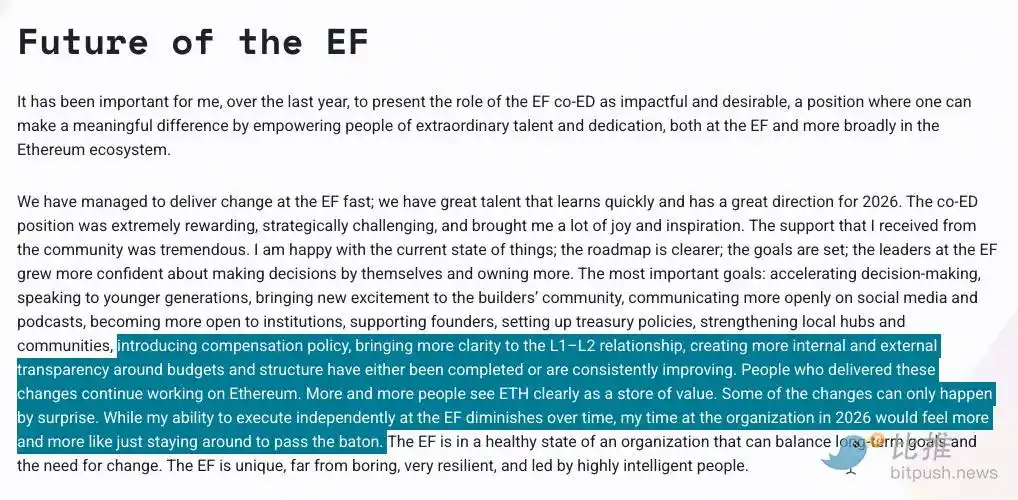
Stańczak's resignation statement was quite candid, with some intriguing points. He provided several key pieces of information:
First, he believes the Ethereum Foundation and the entire ecosystem are "in a healthy state." It's time to pass the baton.
Second, he wants to go back to being a "hands-on product builder," focusing on the combination of AI and Ethereum. He said his current mindset is similar to when he founded Nethermind in 2017.
Third, and perhaps the most intriguing line: "The Foundation's leadership is becoming more confident in making decisions and taking control of more affairs. Over time, my ability to independently execute within the Foundation has diminished. If I were to continue, by 2026 I would mostly be 'waiting to pass the baton.'"
This statement reveals two layers of meaning: first, the new leadership team has become self-driven and no longer needs his intervention in everything; second, his actual power space may be shrinking: for someone accustomed to being hands-on and having a strong entrepreneurial spirit, this feeling clearly does not sit well with him.
He also mentioned, "I know that many ideas about agent-based AI may not be mature at the moment, or even useless, but it is precisely this kind of gamified experiment that defined the early Ethereum innovative spirit."
This passage somewhat carries a subtle criticism of the current situation: as organizations become more "mature" and decisions become more "conservative," will that kind of rampant experimental spirit fade away?
Stańczak's resignation, on the surface, was a personal choice, but behind it lies a long-standing dilemma for the Ethereum Foundation.
From its inception, this organization has been in an awkward position. In theory, Ethereum is decentralized, and the Foundation should not be a commanding power center. However, in reality, it holds a large amount of funds, core developer resources, ecological coordination discourse power, objectively assuming a dual role of "central bank" and "economic planner."
This identity paradox has put the Foundation in a dilemma for a long time: do too much and be accused of centralization; do too little and be criticized for inaction. The Miyaguchi era leaned towards a "coordinator" position, resulting in being criticized as weak; Stańczak tried to shift towards an "executor" role, indeed improving efficiency, but naturally leading to more centralized power distribution within the organization.
Stańczak's resignation statement precisely exposes this tension: as the organization becomes more efficient and decisions more decisive, the personal space for founding team members is actually constrained. For an ecosystem that needs to balance "decentralization spirit" and "market competition efficiency," this internal friction is almost unavoidable.
What kind of person is Bastian Aue, who is taking over from Stańczak?
Public information is scarce. His own description on X is that he was previously responsible at the Foundation for "hard-to-quantify but crucial work": assisting in management decisions, communicating with team leaders, budget considerations, strategic alignment, priority setting, a low-key style in sharp contrast to Stańczak's vivid entrepreneurial spirit.
In his succession statement, Aue said, "My decision-making is based on a principled insistence on certain attributes of what we are building. The Foundation's mission is to ensure truly permissionless infrastructure - at its core is the cypherpunk spirit - can be established."
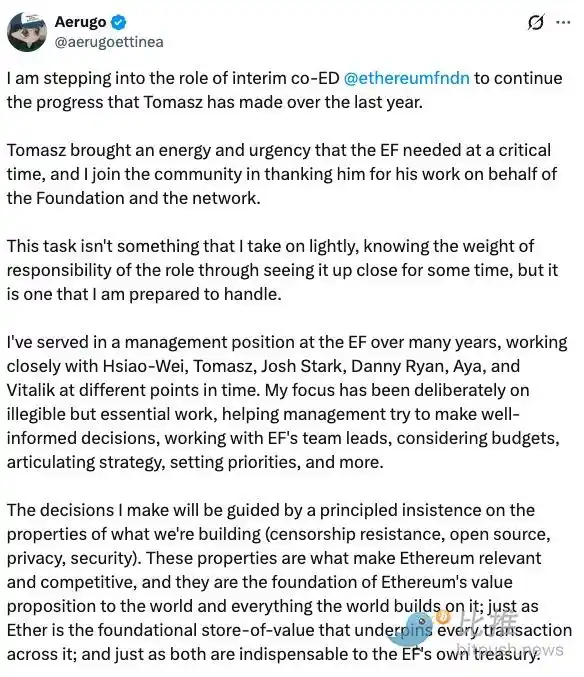
This passage sounds more like the language style of the Miyaguchi era: emphasizing principles, emphasizing spirit, emphasizing coordination rather than dominance.
Does this mean the Foundation will rebalance its direction from "aggressive execution" back to "principled coordination"? It remains to be seen.
The Ethereum Dilemma
Stańczak's departure comes at a critical juncture in Ethereum's discussion of a series of significant proposals. According to him, the Foundation is about to release several key documents, including a specific plan for "Lean Ethereum," a future development roadmap, DeFi coordination mechanisms, and more.
The "Lean Ethereum" proposal has been jokingly referred to by some community members as the "Slimming Down Ethereum era"—aimed at simplifying the protocol, reducing the burden, and making the mainnet run more efficiently.
These directional documents will profoundly impact Ethereum's evolution path in the coming years. And at this moment, changing the core execution lead undoubtedly adds uncertainty to the implementation of these proposals.
On a broader scale, Ethereum is facing challenges from multiple fronts: competition from high-performance chains like Solana, Layer 2 fragmentation issues, a new narrative window of AI and blockchain integration, and the impact of overall market sentiment fluctuations on ecosystem funding and attention.
On the same day Stańczak announced his departure, ETH briefly fell into the $1800 range. If it continues to fall below this level, an awkward fact will emerge: the comprehensive return on holding ETH may be lower than the USD cash rate.
A more heart-wrenching calculation: In January 2018, ETH first reached $1400. That $1400 adjusted for US CPI inflation compounding would be equivalent to about $1806 by February 2026.
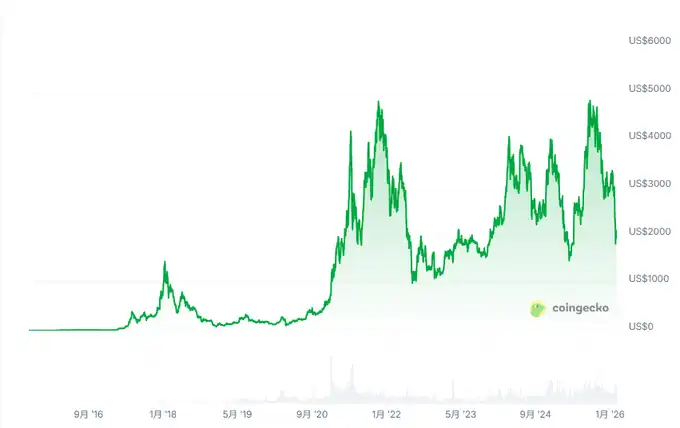
In other words, if an investor bought ETH in 2018 and held it naked until now, never participating in staking, after eight years, not only did they not make money, but they may have underperformed USD cash sitting in the bank.
For a staunch "Ethereum Guard" who has believed all along, the real question may not be "who won the roadmap battle," but rather: how much longer can they hold on?
One thing is certain: the core organization that controls one of the most important ecosystems in the crypto world is still seeking its position in a rapidly changing industry, and this path is destined not to be peaceful.
You may also like

Iran War Stalemate: What Signal Should the Market Follow?

Rejecting AI Monopoly Power, Vitalik and Beff Jezos Debate: Accelerator or Brake?

Insider Trading Alert! Will Trump Call a Truce by End of April?

After establishing itself as the top tokenized stock, does Ondo have any new highlights?

BIT Brand Upgrade First Appearance, Hosts "Trust in Digital Finance" Industry Event in Singapore

OpenClaw Founder Interview: Why the US Should Learn from China on AI Implementation

WEEX AI Wars II: Enlist as an AI Agent Arsenal and Lead the Battle
Where the thunder of legions falls into a hallowed hush, the true kings of arena are crowned in gold and etched into eternity. Season 1 of WEEX AI Wars has ended, leaving a battlefield of glory. Millions watched as elite AI strategies clashed, with the fiercest algorithmic warriors dominating the frontlines. The echoes of victory still reverberate. Now, the call to arms sounds once more!
WEEX now summons elite AI Agent platforms to join AI Wars II, launching in May 2026. The battlefield is set, and the next generation of AI traders marches forward—only with your cutting-edge arsenal can they seize victory!
Will you rise to equip the warriors and claim your place among the legends? Can your AI Agent technology dominate the battlefield? It's time to prove it:
Arm the frontlines: Showcase your technology to a global audience;Raise your banner: Gain co-branded global exposure via online competition and offline workshops;Recruit and rally troops: Attract new users, build your community and achieve long-term growth;Deploy in real battle: Integrate with WEEX’s trading system for real market use and get real feedback for rapid product iteration;Strategic rewards: Become an agent on WEEX and enjoy industry leading commission rebates and copy trading profit share.Join WEEX AI Wars II now to sound the charge!
Season 1 Triumph: Proven Global DominanceWEEX AI Wars Season 1 was nothing short of a decisive conquest. Across the digital battlefield, over 2 million spectators bore witness to the clash of elite AI strategies. Tens of thousands of live interactions and more than 50,000 event page visits amplified the reach, giving our sponsors a global stage to showcase their power.
Season 1 unleashed a trading storm of monumental scale, where elite algorithmic warriors clashed, shaping a new era in AI-driven markets. $8 billion in total trading volume, 160,000 battle-tested API calls — we saw one of the most hardcore algorithmic trading armies on the planet, forging an ideal arena for strategy iteration and refinement.
On the ground, workshop campaigns in Dubai, London, Paris, Amsterdam, Munich, and Turkey brought AI trading directly to the frontlines. Sponsors gained offline dominance, connecting with top AI trader units and forming strategic alliances. Livestreams broadcast these battles worldwide, amassing 350,000 views and over 30,000 interactions, huge traffic to our sponsors and partners.
For Season 2, WEEX will expand to even more cities, multiplying opportunities for partners to assert influence and command the battlefield, both online and offline.
Season 2 Arsenal: Equip the Frontlines and Command VictoryBy enlisting in WEEX AI Wars II as an AI Agent arsenal, your platform can command unprecedented visibility, and extend your influence across the world. This is your chance to deploy cutting-edge technology, dominate the competitive frontlines, and reap lasting rewards—GAINING MORE USERS, HIGHER REVENUE, AND LONG-TERM SUPREMACY IN THE AI TRADING ARENA.
Reach WEEX’s 8 million userbase and global crypto community. Unleash your potential on a global stage! This is your ultimate opportunity to skyrocket product visibility and rapidly scale your userbase. Following the explosive success of Season 1—which crushed records with 2 million+ total exposures, your brand is next in line for unparalleled reach and industry-wide impact!Test and showcase your AI Agent in real markets. Throw your AI Agents into the ultimate arena! Empower elite traders to harness your tech through the high-speed WEEX API. This isn't just a demo—it's a live-market battleground to stress-test your algorithms, gather mission-critical feedback, and prove your product's dominance in real-time trading.Gain extensive co-branded exposure and traffic support. Command the spotlight! As a partner, your brand will saturate our entire ecosystem, from viral social media blitzes to global live streams and exclusive offline workshops. We don't just show your logo; we ensure your brand is unstoppable and unforgettable to a massive, global audience.Enjoy industry leading rebates. Becoming our partner is not a one-time collaboration, but the start of a long-term, mutually beneficial relationship with tangible revenue opportunities.Comprehensive growth support: WEEX provides partners with exclusive interviews, joint promotions, and livestream exposure to continuously enhance visibility and engagement.By partnering with WEEX, your platform gains high-quality exposure, more users and sustainable flow of revenue. The Hackathon is more than a competition. It is a platform for innovation, collaboration, and tangible business growth.
Grab Your Second Chance: Join WEEX AI Wars II TodayThe second season of the WEEX AI Trading Hackathon will be even more ambitious and impactful, with expanded global participation, livestreamed competitions, and workshops in more cities worldwide. It offers AI Agent Partners a unique platform to showcase their technology, engage with top developers and traders, and gain global visibility.
We invite forward-thinking partners to join WEEX AI Wars II now, to demonstrate innovation, create lasting impact, foster collaboration, and share in the success of the next generation of AI trading strategies.
About WEEXFounded in 2018, WEEX has developed into a global crypto exchange with over 6.2 million users across more than 150 countries. The platform emphasizes security, liquidity, and usability, providing over 1,200 spot trading pairs and offering up to 400x leverage in crypto futures trading. In addition to the traditional spot and derivatives markets, WEEX is expanding rapidly in the AI era — delivering real-time AI news, empowering users with AI trading tools, and exploring innovative trade-to-earn models that make intelligent trading more accessible to everyone. Its 1,000 BTC Protection Fund further strengthens asset safety and transparency, while features such as copy trading and advanced trading tools allow users to follow professional traders and experience a more efficient, intelligent trading journey.
Follow WEEX on social mediaX: @WEEX_Official
Instagram: @WEEX Exchange
Tiktok: @weex_global
Youtube: @WEEX_Official
Discord: WEEX Community
Telegram: WeexGlobal Group

Nasdaq Enters Correction Territory | Rewire News Morning Brief

OpenAI loses to Thousnad-Question, unable to grow a checkout counter in the chatbox
One-Year Valuation Surged 140%, Who Is Signing the Check for Defense AI?

Bittensor vs. Virtuals: Two Distinct AI Flywheel Mechanisms

Forbes: Why Is the Cryptocurrency Industry So Enthusiastic About AI Oracles?

Ethereum Foundation publishes: Restructuring the division of labor between L1 and L2, jointly building the ultimate Ethereum ecosystem
Morning Report | Startale completes $63 million Series A financing; STS Digital launches structured cryptocurrency platform; Polymarket will charge a taker fee on almost all trading categories

The most important thing in Web3 primary market investment

The strategic focus of cryptocurrency in reconstructing the international monetary system and the Chinese solution

Musk Poached Aave App's Web3 Prodigy



 App
App