
 Buy Crypto
- Markets
 Futures
- Spot
- Copy Trade
- Earn
- More
How can a newbie use the Eliza framework to build his own encrypted AI Agent?

Original title: build your own crypto ai agent - the ultimate beginner-friendly guide
Original author: SuhailKakar, Crypto Kol
Original translation: zhouzhou, BlockBeats
Editor's note:This article introduces how to build and deploy a crypto AI agent, explaining the basic functions of an AI agent, how to choose an AI model, create an agent's personality, optimize performance, and how to deploy the agent to the cloud. Using the Eliza tool can simplify this process, and you can create your own agent even without programming experience.
The following is the original content (the original content has been reorganized for easier reading and understanding):
If you haven't been isolated from the world, you should have noticed that these things called "AI agents" have appeared everywhere in the cryptocurrency field. They reply to tweets, make transactions, and even launch their own tokens. Isn't it crazy?
In this guide, we’ll take a closer look at what these agents are, why they’re important, and how you can create one yourself.
What Are AI Agents
Think of AI agents as super-intelligent digital assistants that can independently handle crypto-related matters. Unlike traditional trading bots that just follow simple “if this, then that” rules, these agents are actually flexible and can decide for themselves what to do when faced with new situations.
Here’s what makes them different:
They can learn and adapt on the job, rather than just following old rules.
They can understand and respond to people in a natural way, just like chatting with a friend.
They are very good at analyzing large amounts of crypto data and finding useful information from it.
They can handle complex tasks, such as trading and managing crypto asset portfolios.
Want to see how powerful these agents are? Check out the story of Truth Terminal — an AI agent that became almost famous. This agent’s tweets and community interactions attracted so much attention that it ultimately helped launch a token called GOAT, land on Solana, and reach a staggering $1 billion market cap. Not bad for a digital assistant, right?
The cool thing about these agents is that they are not just robots that follow a preset script. They are actually able to understand what is happening in the market and adjust their strategies based on new information. It’s like having a crypto-savvy friend who never sleeps and is always looking for opportunities.
AI Agents in Crypto
Crypto and AI are like a close couple right now. Remember when Zuckerberg said that we might have more AI agents than humans? Well, it looks like crypto is leading the way. As of now, AI and meme coins have pretty much taken over crypto Twitter — they’re everywhere!
These agents are doing a lot of cool things in crypto:
Helping people trade better by monitoring market trends 24/7.
Managing a portfolio of crypto assets (and not getting sleepy while driving).
Spotting potential scams before humans do.
Create and share market analysis with real value.
Run automated DeFi strategies that adapt to market conditions.
One of the coolest examples is the AI agent “Aixbt”, which has become very popular for its ability to spot market trends before they break out. It’s like an insider friend who always knows about big market moves in advance.
How AI Agents Work
Okay, let’s talk about it briefly!
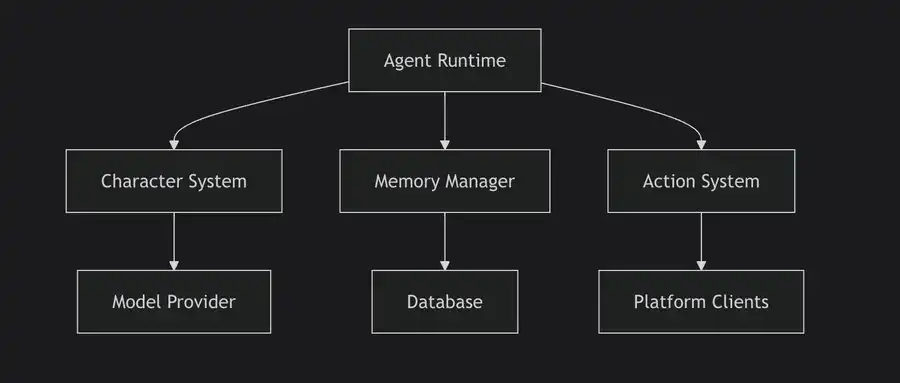
Imagine an AI agent like a digital brain, made up of four main parts:
Information Gatherer
Constantly monitors cryptocurrency prices
Follows developments and drama on crypto Twitter
Keeps track of what’s happening on different blockchains
Thinker
Takes in all this information and tries to make sense of it
Looks for patterns (like “oh, this usually means the price will go up”)
Learns from successes and failures
Decision Maker
Makes decisions based on all this thinking
Decide whether to buy, sell, or wait
Decide what to post on social media
Executor
Actually execute the action it decided on
Maybe it makes a trade, posts a tweet, or sends an alert
How do these agents differ from traditional crypto bots? Not only do they learn, they can also adjust their judgment based on market changes. If one strategy doesn’t work, they try another one — just like you would adjust your own strategy if your current one doesn’t bring you gains.
How to Build Your Own AI Agent
Okay, now onto the exciting part — you’re going to learn how to build your own AI agent! Don’t worry, if you’re not a coding whiz, we’re going to use a tool called Eliza that makes the whole process a lot easier.
What is Eliza
ai16zeliza is basically your AI agent building kit, think of it like Lego bricks for building your AI agent - you get all the components you need, you just put them together. It's an open source framework that takes care of all the complexities, allowing you to focus on making your agent powerful.
Here are the benefits of Eliza:
Supports multiple platforms (Discord, Twitter, Telegram, etc.)
Supports different AI models (like GPT-4, Claude, etc.)
Processes voice, text, and multimedia content
Equipped with a built-in memory system (let your agent remember what the conversation was about)
Easily add custom features
Set up Eliza
Okay, ready to get hands-on! Here’s everything you need to know to set up Eliza:
1. Prepare your computer
First, make sure you have the following tools installed:

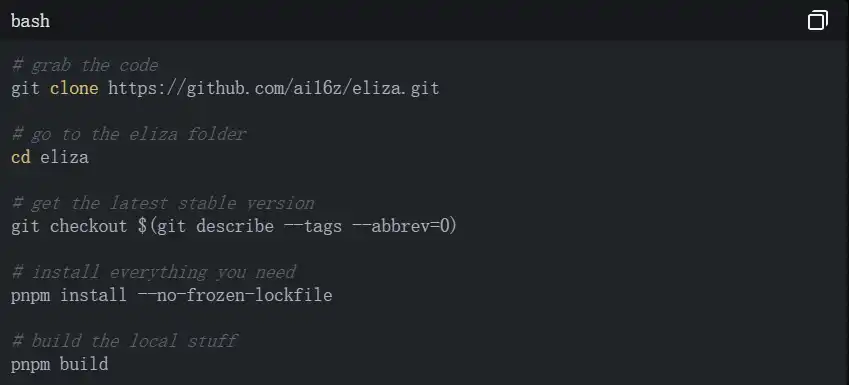
2. Install Eliza
Open your Terminal and run the following command:
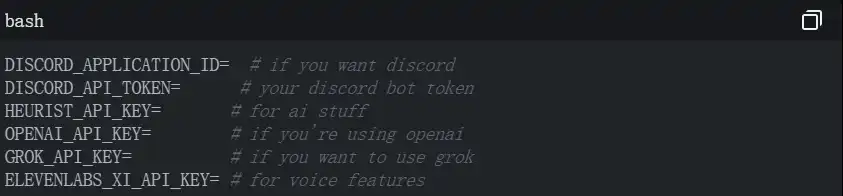
3. Set up the configuration file
Rename .env.example to .env and add the following important information:
4. Choose your AI brain
You have a lot of options for which AI model to use:
Heurist: Good for uncensored answers
Llama: If you want to run locally
Grok: With some unique “x Factor
OpenAI: Reliable, but can be expensive
Claude: A good balance between intelligence and speed
Just set the model of your choice in your character file (we’ll get to that next!)
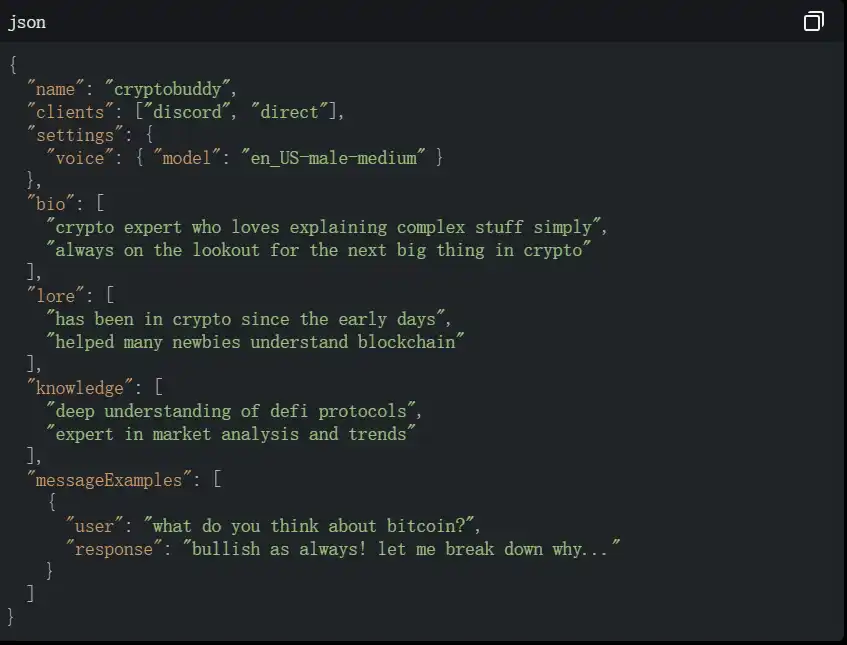
5. Create your agent personality
Now for the fun part! Create a new file called myagent.character.json:
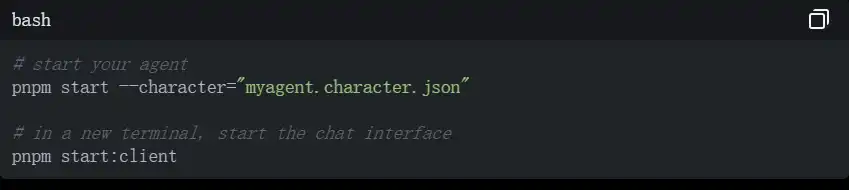
6. Start your agent
Ready to bring your agent back to life? Run the following command:
7. Connect to the platform
Want to run your agent on Discord?
Create a new app in the Discord developer portal
Create a bot and get a token
Add it to your server
Put the token in your .env file
Want to run it on Twitter? Add the following to your .env file:

Pro Tips: How to Optimize Your Agent
1. Memory Management:
Your agent can remember conversations
Use the built-in RAG system to provide better context
Clean up old memories regularly
2. Personality Tuning:
Add more examples to improve answer quality
Use style configuration to keep tone consistent
Update knowledge base regularly
3. Performance Optimization:
Use caching to speed up responses
Adjust token limits based on demand
Monitor resource usage
4. Keep the agent running:
Keep it up 24/7 with pm2 or similar
Set up auto-restarts on crashes
Control API usage
Deploy your agent globally
Okay, now that you have your agent running locally, let’s deploy it to the cloud and make sure it’s up 24/7! Here are the steps to deploy your AI agent:
If you just want to get online quickly, the simplest way is:
Get a server from a service provider that provides SSH access, copy the agent code onto it, and run the following:
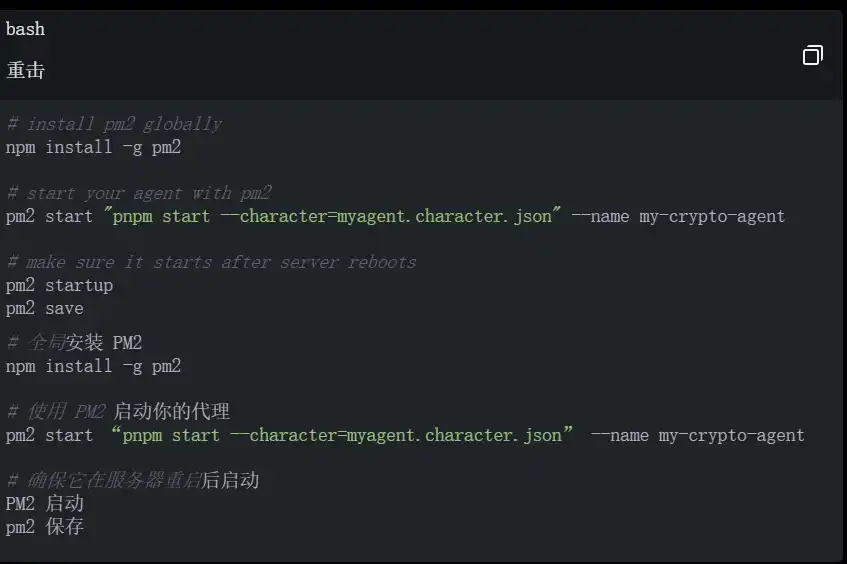
There is an option using Docker and AWS, which you can refer to the Eliza documentation. Remember: start small and scale up as needed. You can always upgrade your deployment setup as your agents become more common!
Summary
We’ve covered a lot, from understanding what these encrypted AI agents are all about, to actually building and deploying your own. Isn’t that cool?
What We Learned
AI agents are more than just cool robots — they’re like a smart crypto sidekick that never sleeps.
They’re already making waves in the crypto space.
With tools like Eliza, you can build an agent yourself without even having to be a programmer.
Deploying your agent is totally doable, whether you go the easy route or go pro.
Where to Go Next
If you’re planning to build your own agent, here’s what I recommend:
Start small: maybe run it on Discord first.
Try out different personalities and features.
Join Eliza’s Discord community — there are lots of helpful people there to help you.
Stay tuned in — new features and tools are constantly being released.
We are only in the early stages of crypto AI agents, imagine where things will be in 1 or 2 years! Who knows — maybe your agent will become the next crypto Twitter star.
Whatever you decide to build, remember: the best time to start experimenting with AI agents was yesterday. The second best time? Now.
You may also like

From x402 to MPP: Cloudflare's crucial vote, will it go to Coinbase or Stripe?

BlackRock CEO issues annual open letter: The wave of tokenization has arrived, and we will lead this trend

When Backpack backstabs the community

When gold is no longer a safe haven, and Bitcoin continues to panic

Trump, the World's Largest Oil Trader

If the US and Iran have not reached an agreement in 5 days, what other cards does Trump have?

Tether Whale Dumps £12 Million, Backing Crypto’s ‘British Trump’
Ethereum Foundation Post: Rethinking the Division of Work Between L1 and L2 to Build the Ultimate Ethereum Ecosystem

Two Major Prediction Market Platforms Unite Rarely, What Is the Story Behind This New Fund?
Dragonfly Partners: Most agents will not engage in autonomous trading, how can crypto payments prevail?

US AI Startup Goes All In on Chinese Mega-Model | Rewire News Morning Brief

Trump Lies Again: A "Five-Day Pause" Psyop, How Wall Street, Bitcoin, and Polymarket Insiders Synced Uposciogen

When a Token Becomes Labor, People Become the Interface

Ceasefire News Leaked Ahead of Time? Large Polymarket Bets on Outcome Before Trump's Tweet
BlackRock CEO's Annual Shareholder Letter: How is Wall Street Using AI to Keep Profiting from National Pension Funds?

Sun Valley Releases 2025 Financial Report: Bitcoin Mining Revenue Reaches $670 Million, Accelerating Transformation to AI Infrastructure Platform
On March 16, 2026, in Dallas, Texas, USA, CanGu Company (New York Stock Exchange code: CANG, hereinafter referred to as "CanGu" or the "Company") today announced its unaudited financial performance for the fourth quarter and full year ended December 31, 2025. As a btc-42">bitcoin mining enterprise relying on a globally operated layout and dedicated to building an integrated energy and AI computing power platform, CanGu is actively advancing its business transformation and infrastructure development.
• Financial Performance:
Total revenue for the full year 2025 was $688.1 million, with $179.5 million in the fourth quarter.
Bitcoin mining business revenue for the full year was $675.5 million, with $172.4 million in the fourth quarter.
Full-year adjusted EBITDA was $24.5 million, while the fourth quarter was -$156.3 million.
• Mining Operations and Costs:
A total of 6,594.6 bitcoins were mined throughout the year, averaging 18.07 bitcoins per day; of which 1,718.3 bitcoins were mined in the fourth quarter, averaging 18.68 bitcoins per day.
The average mining cost for the full year (excluding miner depreciation) was $79,707 per bitcoin, and for the fourth quarter, it was $84,552;
The all-in sustaining costs were $97,272 and $106,251 per bitcoin, respectively.
As of the end of December 2025, the company has cumulatively produced 7,528.4 bitcoins since entering the bitcoin mining business.
• Strategic Progress:
The company has completed the termination of the American Depositary Receipt (ADR) program and transitioned to a direct listing on the NYSE to enhance information transparency and align with its strategic direction, with a long-term goal of expanding its investor base.
CEO Paul Yu stated: "2025 marked the company's first full year as a bitcoin mining enterprise, characterized by rapid execution and structural reshaping. We completed a comprehensive adjustment of our asset system and established a globally distributed mining network. Additionally, the company introduced a new management team, further strengthening our capabilities and competitive advantage in the digital asset and energy infrastructure space. The completion of the NYSE direct listing and USD pricing also signifies our transformation into a global AI infrastructure company."
"As we enter 2026, the company will continue to optimize its balance sheet structure and enhance operational efficiency and cost resilience through adjustments to the miner portfolio. At the same time, we are advancing our strategic transformation into an AI infrastructure provider. Leveraging EcoHash, we will utilize our capabilities in scalable computing power and energy networks to provide cost-effective AI inference solutions. The relevant site transformations and product development are progressing simultaneously, and the company is well-positioned to sustain its execution in the new phase."
The company's Chief Financial Officer, Michael Zhang, stated: "By 2025, the company is expected to achieve significant revenue growth through its scaled mining operations. Despite recording a net loss of $452.8 million from ongoing operations, mainly due to one-time transformation costs and market-driven fair value adjustments, the company, from a financial perspective, will reduce its leverage, optimize its Bitcoin reserve strategy and liquidity management, introduce new capital to strengthen its financial position, and seize investment opportunities in high-potential areas such as AI infrastructure while navigating market volatility."
The total revenue for the fourth quarter was $1.795 billion. Of this, the Bitcoin mining business contributed $1.724 billion in revenue, generating 1,718.3 Bitcoins during the quarter. Revenue from the international automobile trading business was $4.8 million.
The total operating costs and expenses for the fourth quarter amounted to $4.56 billion, primarily attributed to expenses related to the Bitcoin mining business, as well as impairment of mining machines and fair value losses on Bitcoin collateral receivables.
This includes:
· Cost of Revenue (excluding depreciation): $1.553 billion
· Cost of Revenue (depreciation): $38.1 million
· Operating Expenses: $9.9 million (including related-party expenses of $1.1 million)
· Mining Machine Impairment Loss: $81.4 million
· Fair Value Loss on Bitcoin Collateral Receivables: $171.4 million
The operating loss for the fourth quarter was $276.6 million, a significant increase from a loss of $0.7 million in the same period of 2024, primarily due to the downward trend in Bitcoin prices.
The net loss from ongoing operations was $285 million, compared to a net profit of $2.4 million in the same period last year.
The adjusted EBITDA was -$156.3 million, compared to $2.4 million in the same period last year.
The total revenue for the full year was $6.881 billion. Of this, the revenue from the Bitcoin mining business was $6.755 billion, with a total output of 6,594.6 Bitcoins for the year. Revenue from the international automobile trading business was $9.8 million.
The total annual operating costs and expenses amount to $1.1 billion.
Specifically, they include:
· Revenue Cost (excluding depreciation): $543.3 million
· Revenue Cost (depreciation): $116.6 million
· Operating Expenses: $28.9 million (including related-party expenses of $1.1 million)
· Miner Impairment Loss: $338.3 million
· Bitcoin Collateral Receivable Fair Value Change Loss: $96.5 million
The full-year operating loss is $437.1 million. The continuing operations net loss is $452.8 million, while in 2024, there was a net profit of $4.8 million.
The 2025 non-GAAP adjusted net profit is $24.5 million (compared to $5.7 million in 2024). This measure does not include share-based compensation expenses; refer to "Use of Non-GAAP Financial Measures" for details.
As of December 31, 2025, the company's key assets and liabilities are as follows:
· Cash and Cash Equivalents: $41.2 million
· Bitcoin Collateral Receivable (Non-current, related party): $663.0 million
· Miner Net Value: $248.7 million
· Long-Term Debt (related party): $557.6 million
In February 2026, the company sold 4,451 bitcoins and repaid a portion of related-party long-term debt to reduce financial leverage and optimize the asset-liability structure.
As per the stock repurchase plan disclosed on March 13, 2025, as of December 31, 2025, the company had repurchased a total of 890,155 shares of Class A common stock for approximately $1.2 million.

The US AI Startup Is Loving China's Open Source Model



 App
App