
 Buy Crypto
- Markets
 Futures
- Spot
- Copy Trade
- Earn
- More
Full text of the draft of "U.S. Strategic Bitcoin Reserve": Manage BTC as a permanent national asset

Original source: Bitcoin Policy Institute
Original translation: BitpushNews
On December 17, 2024, the Bitcoin Policy Institute drafted an executive order proposing to establish a strategic Bitcoin reserve under the Trump administration's U.S. Treasury Exchange Stabilization Fund (ESF), which needs to be signed after Trump takes office to take effect.
Bitpush Note: The Bitcoin Policy Institute is a nonpartisan, nonprofit organization dedicated to studying the policy and social impact of Bitcoin and emerging currency networks.
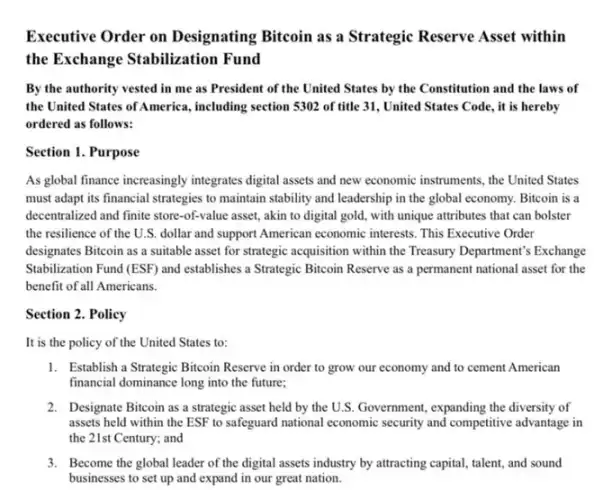
Below is the full text of the Executive Order:
By the authority vested in me by the Constitution and the laws of the United States, including 31 U.S.C. Section 5302, it is hereby ordered as follows:
Section 1. Purpose
As global finance increasingly integrates digital assets and new economic instruments, the United States must adapt its financial strategy to maintain global economic stability and leadership. Bitcoin is a decentralized, finite store of value asset, similar to digital gold, with unique properties that enhance the resiliency of the dollar and support U.S. economic interests.
This Executive Order designates Bitcoin as an asset suitable for strategic acquisition within the Treasury’s Exchange Stabilization Fund (ESF), establishes a strategic Bitcoin reserve, and maintains it as a permanent national asset for the benefit of all Americans.
Section 2. Policy
It is the policy of the United States:
1. Establish a Strategic Bitcoin Reserve to grow our economy and solidify America’s future financial dominance;
2. Designate Bitcoin as a strategic asset held by the U.S. Government, broaden the diversity of assets held by the ESF to protect national economic security and competitive advantage in the 21st century, and promote industry development by attracting capital, talent, and voices;
3. Become a global leader in the digital asset industry, building and expanding businesses across our great nation.
Section 3. Establishment of the SBR and Designation of Bitcoin as a Strategic Reserve Asset
(a) Establishment of a Strategic Bitcoin Reserve
The Strategic Bitcoin Reserve (SBR) is hereby established to be managed by the Secretary of the Treasury and to enhance the diversity of the United States’ reserve assets. To enhance confidence in its mission, the SBR will be subject to regular audits, rigorous security standards, and comprehensive reporting measures to ensure long-term accountability and security.
(b) Consolidation of Government Bitcoin Holding
Not later than 7 days after the date of this order, any bitcoin under the control of any Federal agency, including the United States Marshals Service, shall not be sold, exchanged, auctioned, or otherwise pledged and shall be transferred to the SBR by the head of such Federal agency upon acquisition of legal title to such bitcoin, including upon final, nonappealable judgment in a criminal or civil forfeiture action in favor of the Federal agency.
(c) Designation of Reserve Asset
Bitcoin is hereby designated as a strategic reserve asset suitable for purchase and holding within the ESF. Not later than 60 days after the date of this order, the Secretary of the Treasury is hereby directed to implement a Bitcoin Acquisition Program to acquire and manage Bitcoin within the ESF. The goal of the SBR is to position the United States as the undisputed world leader in Bitcoin holding, innovation, and management, ensuring that U.S. interests, rather than those of foreign competitors, set the standard for global digital asset strategy.
SECTION 4. ACQUISITION AND CUSTODY AGREEMENTS
(a) Acquisition Program
Pursuant to 31 U.S.C. 4 5302, which authorizes the Secretary of the Treasury to “deal with … credit instruments,” the Secretary of the Treasury is hereby directed to appropriate not less than $521 billion from the ESF for the strategic acquisition of Bitcoin for inclusion in the SBR, in a manner consistent with the Secretary’s obligations under law, by purchasing obligations from appropriate counterparties and repaying them in Bitcoin. The Secretary of the Treasury shall work with reputable market participants pursuant to agreements that maximize value and mitigate risk. The initial acquisition program shall be completed not later than 365 days after the date of this order.
(b) Custody and Security Protocols
In order to safeguard the SBR’s bitcoin holdings at all stages, the Secretary of the Treasury shall implement the following phased custody framework. Within 30 days of the date of this order, the Secretary shall confirm that the U.S. Government’s existing relationships with reputable and secure custody service providers are sufficient to ensure immediate, trusted storage solutions for bitcoin within the SBR. The Secretary shall direct that all bitcoin purchases under the acquisition program be securely transferred to such custody service providers.
In parallel, the Secretary shall coordinate with the National Security Agency, the Cybersecurity and Infrastructure Security Agency, the National Institute of Standards and Technology (NIST), and any other agencies requested by the Secretary to develop and implement self-custody protocols (including dedicated hardware, assured software, access controls, geographic distribution, multi-signature controls, and physical security measures) designed to enhance long-term security, reduce reliance on third parties, and maintain full sovereign control over the United States’ bitcoin reserves as a “digital Fort Knox.” The Secretary should ensure that the SBR custody agreement is consistent with ESF audit procedures, rigorous cybersecurity standards, and cryptographic proof of reserve verification to safeguard the integrity of the SBR and the confidence of the American public.
Section 5. Conditions for Sale of the Strategic Bitcoin Reserve
(a) Long-Term Preservation
The SBR should serve as a permanent pillar of America’s financial strength and commitment to the future of the digital economy, in the same enduring spirit that preserved our nation’s gold reserve at Fort North. Bitcoin held in the SBR should not be viewed as a short-term financial instrument or a rainy day fund for day-to-day emergencies, but rather as a generational asset that supports America’s prosperity and security for decades to come. It is the policy of the United States. The Government shall hold (HODL) all Bitcoin acquired in the SBR for at least 25 years after the date of this order.
(b) Strict Limitations on Liquidation
Sales or other divestments of the SBR should be permitted only in the most dire and extraordinary circumstances, which clearly outweigh ordinary financial volatility or geopolitical uncertainty.
(c) Rigorous Approval Process
Before any sale is made, the Secretary of the Treasury shall submit a detailed written decision, accompanied by substantial evidence, demonstrating that the proposed liquidation is in direct response to an extraordinary national economic or security crisis. The decision must be approved by the President of the United States. The Secretary of the Treasury shall not be authorized to sell, pledge, exchange, or otherwise dispose of any portion of the SBR without express authorization.
(d) Transparent and Controlled Execution
In the rare circumstances in which a sale is approved, it should be conducted through the most sensible and tightly controlled methods to minimize market impact and maintain public confidence. Preference should be given to private, staged transactions or other measured methods that ensure that, even in a crisis, the nation's reputation for financial prudence and responsibility remains intact.
Section 6. Reporting and Transparency
(a) Public Reserve Certification
The Secretary of the Treasury shall implement a public reserve certification process using cryptographic certifications. These certifications shall be provided on a quarterly basis to ensure transparency of the ESF’s bitcoin holdings while protecting sensitive security information.
(b) Annual Report
As part of the annual report on the operations of the ESF required by the Gold Reserve Act, the Secretary of the Treasury shall provide detailed information on the status, performance, and strategic advantages of bitcoin within the ESF. The report shall also summarize acquisition strategies, custodial security measures, and impacts on economic stability, subject to considerations of national economic security.
Section 7. Interagency Coordination
The Secretary of the Treasury shall coordinate with the Federal Reserve, the Department of Defense, and other relevant Federal agencies to ensure that the acquisition and management of bitcoin within the ESF is consistent with United States national security, economic stability, and cybersecurity standards.
You may also like

From x402 to MPP: Cloudflare's crucial vote, will it go to Coinbase or Stripe?

BlackRock CEO issues annual open letter: The wave of tokenization has arrived, and we will lead this trend

When Backpack backstabs the community

When gold is no longer a safe haven, and Bitcoin continues to panic

Trump, the World's Largest Oil Trader

If the US and Iran have not reached an agreement in 5 days, what other cards does Trump have?

Tether Whale Dumps £12 Million, Backing Crypto’s ‘British Trump’
Ethereum Foundation Post: Rethinking the Division of Work Between L1 and L2 to Build the Ultimate Ethereum Ecosystem

Two Major Prediction Market Platforms Unite Rarely, What Is the Story Behind This New Fund?
Dragonfly Partners: Most agents will not engage in autonomous trading, how can crypto payments prevail?

US AI Startup Goes All In on Chinese Mega-Model | Rewire News Morning Brief

Trump Lies Again: A "Five-Day Pause" Psyop, How Wall Street, Bitcoin, and Polymarket Insiders Synced Uposciogen

When a Token Becomes Labor, People Become the Interface

Ceasefire News Leaked Ahead of Time? Large Polymarket Bets on Outcome Before Trump's Tweet
BlackRock CEO's Annual Shareholder Letter: How is Wall Street Using AI to Keep Profiting from National Pension Funds?

Sun Valley Releases 2025 Financial Report: Bitcoin Mining Revenue Reaches $670 Million, Accelerating Transformation to AI Infrastructure Platform
On March 16, 2026, in Dallas, Texas, USA, CanGu Company (New York Stock Exchange code: CANG, hereinafter referred to as "CanGu" or the "Company") today announced its unaudited financial performance for the fourth quarter and full year ended December 31, 2025. As a btc-42">bitcoin mining enterprise relying on a globally operated layout and dedicated to building an integrated energy and AI computing power platform, CanGu is actively advancing its business transformation and infrastructure development.
• Financial Performance:
Total revenue for the full year 2025 was $688.1 million, with $179.5 million in the fourth quarter.
Bitcoin mining business revenue for the full year was $675.5 million, with $172.4 million in the fourth quarter.
Full-year adjusted EBITDA was $24.5 million, while the fourth quarter was -$156.3 million.
• Mining Operations and Costs:
A total of 6,594.6 bitcoins were mined throughout the year, averaging 18.07 bitcoins per day; of which 1,718.3 bitcoins were mined in the fourth quarter, averaging 18.68 bitcoins per day.
The average mining cost for the full year (excluding miner depreciation) was $79,707 per bitcoin, and for the fourth quarter, it was $84,552;
The all-in sustaining costs were $97,272 and $106,251 per bitcoin, respectively.
As of the end of December 2025, the company has cumulatively produced 7,528.4 bitcoins since entering the bitcoin mining business.
• Strategic Progress:
The company has completed the termination of the American Depositary Receipt (ADR) program and transitioned to a direct listing on the NYSE to enhance information transparency and align with its strategic direction, with a long-term goal of expanding its investor base.
CEO Paul Yu stated: "2025 marked the company's first full year as a bitcoin mining enterprise, characterized by rapid execution and structural reshaping. We completed a comprehensive adjustment of our asset system and established a globally distributed mining network. Additionally, the company introduced a new management team, further strengthening our capabilities and competitive advantage in the digital asset and energy infrastructure space. The completion of the NYSE direct listing and USD pricing also signifies our transformation into a global AI infrastructure company."
"As we enter 2026, the company will continue to optimize its balance sheet structure and enhance operational efficiency and cost resilience through adjustments to the miner portfolio. At the same time, we are advancing our strategic transformation into an AI infrastructure provider. Leveraging EcoHash, we will utilize our capabilities in scalable computing power and energy networks to provide cost-effective AI inference solutions. The relevant site transformations and product development are progressing simultaneously, and the company is well-positioned to sustain its execution in the new phase."
The company's Chief Financial Officer, Michael Zhang, stated: "By 2025, the company is expected to achieve significant revenue growth through its scaled mining operations. Despite recording a net loss of $452.8 million from ongoing operations, mainly due to one-time transformation costs and market-driven fair value adjustments, the company, from a financial perspective, will reduce its leverage, optimize its Bitcoin reserve strategy and liquidity management, introduce new capital to strengthen its financial position, and seize investment opportunities in high-potential areas such as AI infrastructure while navigating market volatility."
The total revenue for the fourth quarter was $1.795 billion. Of this, the Bitcoin mining business contributed $1.724 billion in revenue, generating 1,718.3 Bitcoins during the quarter. Revenue from the international automobile trading business was $4.8 million.
The total operating costs and expenses for the fourth quarter amounted to $4.56 billion, primarily attributed to expenses related to the Bitcoin mining business, as well as impairment of mining machines and fair value losses on Bitcoin collateral receivables.
This includes:
· Cost of Revenue (excluding depreciation): $1.553 billion
· Cost of Revenue (depreciation): $38.1 million
· Operating Expenses: $9.9 million (including related-party expenses of $1.1 million)
· Mining Machine Impairment Loss: $81.4 million
· Fair Value Loss on Bitcoin Collateral Receivables: $171.4 million
The operating loss for the fourth quarter was $276.6 million, a significant increase from a loss of $0.7 million in the same period of 2024, primarily due to the downward trend in Bitcoin prices.
The net loss from ongoing operations was $285 million, compared to a net profit of $2.4 million in the same period last year.
The adjusted EBITDA was -$156.3 million, compared to $2.4 million in the same period last year.
The total revenue for the full year was $6.881 billion. Of this, the revenue from the Bitcoin mining business was $6.755 billion, with a total output of 6,594.6 Bitcoins for the year. Revenue from the international automobile trading business was $9.8 million.
The total annual operating costs and expenses amount to $1.1 billion.
Specifically, they include:
· Revenue Cost (excluding depreciation): $543.3 million
· Revenue Cost (depreciation): $116.6 million
· Operating Expenses: $28.9 million (including related-party expenses of $1.1 million)
· Miner Impairment Loss: $338.3 million
· Bitcoin Collateral Receivable Fair Value Change Loss: $96.5 million
The full-year operating loss is $437.1 million. The continuing operations net loss is $452.8 million, while in 2024, there was a net profit of $4.8 million.
The 2025 non-GAAP adjusted net profit is $24.5 million (compared to $5.7 million in 2024). This measure does not include share-based compensation expenses; refer to "Use of Non-GAAP Financial Measures" for details.
As of December 31, 2025, the company's key assets and liabilities are as follows:
· Cash and Cash Equivalents: $41.2 million
· Bitcoin Collateral Receivable (Non-current, related party): $663.0 million
· Miner Net Value: $248.7 million
· Long-Term Debt (related party): $557.6 million
In February 2026, the company sold 4,451 bitcoins and repaid a portion of related-party long-term debt to reduce financial leverage and optimize the asset-liability structure.
As per the stock repurchase plan disclosed on March 13, 2025, as of December 31, 2025, the company had repurchased a total of 890,155 shares of Class A common stock for approximately $1.2 million.

The US AI Startup Is Loving China's Open Source Model



 App
App