
 Buy Crypto
- Markets
 Futures
- Spot
- Copy Trade
- Earn
- More
Ethereum Foundation Sets Up a "Dead Man's Switch," Will the Community Buy It?

Original Article Title: "Ethereum Foundation Issues a 'Life-or-Death Promise,' Will the Community Buy It?"
Original Article Author: KarenZ, Foresight News
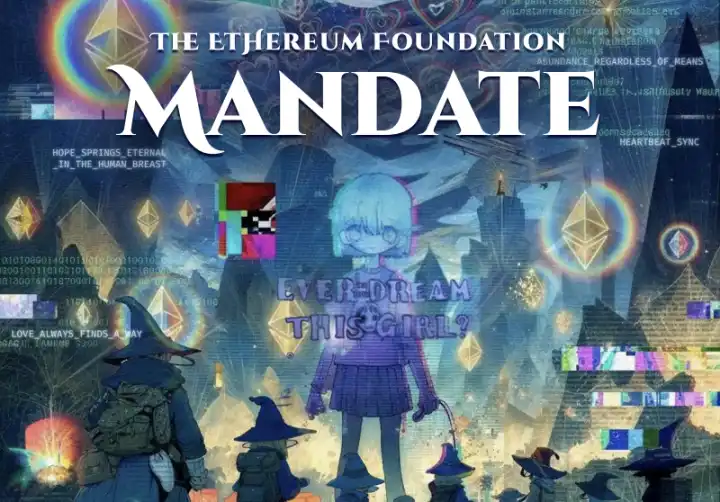
On the evening of March 13, the Ethereum Foundation (EF) board of directors released a mission statement called the "EF Mandate."
As you unfold this mission statement, you may wonder if you've entered the wrong set—the screen full of stars, elves, wizards, and a layout resembling an anime poster. Beneath this cool outer layer lies the current Ethereum ecosystem's "ideological manifesto."
TL;DR
· EF Core Positioning: Guardians, Not Rulers. EF's ultimate goal is to pass the "Walkaway Test"—even if the Ethereum Foundation dissolves in place tomorrow, the Ethereum network can still function perfectly.
· CROPS Immutable Law is the Baseline: Any technical development must meet Censorship Resistance, Open Source, Privacy, and Security. These four attributes are indispensable, and no development priority can outweigh them.
· EF Working Philosophy: The foundation subtracts so Ethereum can be more resilient. When the ecosystem is mature enough, the Ethereum Foundation will gradually decentralize.
· What Not to Do: Not to be a "kingmaker," not to be a rating agency, not to engage in pump-and-dump marketing, and certainly not to encourage Ethereum's use as a "big casino."
· Ultimate Vision: Looking 1,000 years into the future, providing a "digital sanctuary" free from exploitation by power, capital, AI, or even families.
What Exactly Does Ethereum Aim to Solve?
The EF believes that in the digital age, there are two infrastructural essentials: self-sovereignty—controlling one's own data, identity, and assets—and the ability to collaborate with others without being "choked" by anyone (preservation of sovereignty through coordination).
If you only pursue the first point, running a local app is sufficient; if you only pursue the second point, the traditional internet is adequate. Ethereum's unique value lies in achieving both simultaneously.
A passage in the manifesto states: Ethereum's existence is to ensure that no one can "rug" you—whether it's a government, company, institution, or AI.
Around this goal, EF has proposed an acronym: CROPS. This word appears 32 times in the manifesto.
· Censorship Resistance: No one can stop you from doing legal things; even under pressure, cryptographic neutrality holds.
· Open Source & Free: All code and rules are laid out; there are no hidden black boxes.
· Privacy: Your data belongs to you, not the platform. You decide what information to share with whom.
· Security: Protecting the system and users from technological failures and coercion are paramount.
These four attributes are defined in the document as an "indivisible whole," the highest priority, a baseline that must not be compromised for any reason.
The EF's attitude is clear: They would rather go slower but get these things right from day one because once surrendered, it's almost impossible to get them back.
What Does the Foundation Do? What Doesn't It Do?
The EF is treating "making itself unnecessary" as the ultimate success criterion.
There is a term in the document called the "walkaway test," which means: If EF disappeared tomorrow, could Ethereum keep running and evolving on its own? EF's goal is to make the answer to this question "yes."
Therefore, the EF is following a philosophy of "subtractive development": focusing on key tasks in the ecosystem that no one else can or wants to do—core protocol upgrades, long-term technical research, public security. Once a community in a certain area can take over, the EF hands it off, further reducing its relative influence.
At the same time, the EF has drawn up a long list of "don'ts" for itself, reading like a solemn disclaimer: not a company, not a kingmaker, not a certifying body, not a product studio, not a marketing company, not a boss, not a government agency, not a casino, not an opportunist.
When There Is No Standard Answer, How Will EF Decide?
Many lofty principles have been discussed: CROPS, sovereign individuality, subtractive philosophy. But what to do when faced with specific problems? This chapter is the answer.
It's a bit like the foundation's "decision-making algorithm": When faced with two paths, how do you choose without betraying your original intention?
· When choosing a technical solution, choose the one that "won't bottleneck in the future," even if it's slower now. An example in the document is transaction propagation: one solution performs well but relies on a private relay network (whitelist), while another decentralized solution advances slowly. The EF's answer may be the latter because once the former is implemented, the process of "decentralizing later" is unlikely to occur.
· When designing or evaluating proposals, don't just look at the immediate layer; consider the impact on other layers. Some solutions may seem fine in isolation, even aligning with CROPS principles, but when viewed in the entire ecosystem, they may create new issues elsewhere. Don't solve one problem and create ten more.
· User security is crucial, but don't make decisions for users. Only provide users with tools for self-defense, never impose "paternalistic" restrictions. No one should restrict users under the guise of "protecting users" and undermine users' autonomy. For example, some wallets may default to "security mode," covertly block certain contracts, lead users to specific platforms, or even use opaque AI to determine "risky operations" while secretly collecting user behavior—actions that the foundation opposes. Real protection means giving users verifiable filtering tools, publicly available blacklists/whitelists; regardless of the tool, privacy protection is the default, and AI components are no exception.
· Insistent on having intermediaries? Lower the barriers, leave an exit: If some areas currently cannot operate without intermediaries, then minimize entry barriers, allow full market competition, while ensuring users have an "intermediary-free" alternative that is user-friendly and practical.
· When choosing which teams to support, ignore social glamour and focus on actual technical choices. Many projects claim to follow CROPS, but their actual designs hide closed-source core components, impose whitelist restrictions, and guide users along specific paths—these should be approached with caution.
Ideals are lofty, reality is stark
This manifesto is written with great conviction, but the relentless interrogations of reality never cease.
Does this document represent the consensus of all, or just the ideals of some authors? If the EF undergoes personnel changes, does it still hold? Who will oversee the execution?
The more pressing issues are:
· The EF's operational funds heavily rely on holding ETH assets. If the price of ETH dips, the budget will be compressed. "Not caring about the price" is just a mindset discipline, not a financial reality.
· The CROPS rule is an ideal rule, but the world does not operate on CROPS.
· What most users truly care about is: speed, cost-effectiveness, and user-friendliness.
· The EF insists on being "fully CROPS from day one," but will this cause Ethereum to lag behind more "pragmatic" competitors in terms of user experience and commercialization?
· How is the EF's "do" and "don't do" assessed? How is accountability ensured? How is it judged whether "coordination" is good or not?
Community in Turmoil: Punk Idealism vs. Real-World Disconnect
Less than 24 hours since the manifesto was published, community feedback has already polarized:
Critics:
· Eigen Labs researcher Kydo bluntly stated that the EF's current direction is a 180-degree turn, overturning the previous "pragmatic approach" supporting stablecoins, institutional involvement, and RWAs, marginalizing the currently most marketable applications;
· Forward Ind. Chairman mocked: "They build what they want to build, not what you want"—accusing the EF of only building according to idealism, disregarding community and market demands;
· Hazeflow founder Pavel Paramonov called it "another bunch of ideological nonsense," failing to clarify Ethereum's specific direction going forward.
Supporters:
· Namefi founder Zainan Victor Zhou believes this is a constraint on the EF organization, not a restriction on the entire ecosystem;
· Columbia Business School professor Omid Malekan points out that CROPS is precisely the foundation that makes Ethereum a leader in the financial field—it provides true "access + verifiability + property rights protection."
Facing controversy, Vitalik personally stepped in to clarify: This manifesto "is not surprising to many," and is the direction the EF has been contemplating over the past few months. The EF only acts as Ethereum's steward, leaving the rest to the broader ecosystem—this is the starting point of a new chapter.
To conclude, ending with an Italian phrase: "E quindi uscimmo a riveder le stelle" — from Dante's Divine Comedy - Inferno, literally meaning "And so we came forth, and once again beheld the stars."
The EF also created a "SOURCE SEPPUKU LICENSE" meme, stating: "If the Foundation fails to uphold its solemn promise to Ethereum, let it face the consequences and take responsibility."
The EF likened itself to a traveler through hell, willing to endure the trials and doubts of reality in order to advance towards the "digital freedom" star. Of course, only time will tell.
You may also like

WEEX Official Product Launch: Win LALIGA Tickets & Unlock the 3-in-1 Crypto Trading Suite
Trade crypto without downloading an app. Join the WEEX H5, API, SKILLs livestream to explore the new trading experience, win LALIGA VIP tickets, and share 420 USDT rewards.

Dragonfly Partners: Most agents will not engage in autonomous trading, how can crypto payments prevail?

US AI Startup Goes All In on Chinese Mega-Model | Rewire News Morning Brief

Trump Lies Again: A "Five-Day Pause" Psyop, How Wall Street, Bitcoin, and Polymarket Insiders Synced Uposciogen

When a Token Becomes Labor, People Become the Interface

Ceasefire News Leaked Ahead of Time? Large Polymarket Bets on Outcome Before Trump's Tweet

BlackRock CEO's Annual Shareholder Letter: How is Wall Street Using AI to Keep Profiting from National Pension Funds?

Sun Valley Releases 2025 Financial Report: Bitcoin Mining Revenue Reaches $670 Million, Accelerating Transformation to AI Infrastructure Platform
On March 16, 2026, in Dallas, Texas, USA, CanGu Company (New York Stock Exchange code: CANG, hereinafter referred to as "CanGu" or the "Company") today announced its unaudited financial performance for the fourth quarter and full year ended December 31, 2025. As a btc-42">bitcoin mining enterprise relying on a globally operated layout and dedicated to building an integrated energy and AI computing power platform, CanGu is actively advancing its business transformation and infrastructure development.
• Financial Performance:
Total revenue for the full year 2025 was $688.1 million, with $179.5 million in the fourth quarter.
Bitcoin mining business revenue for the full year was $675.5 million, with $172.4 million in the fourth quarter.
Full-year adjusted EBITDA was $24.5 million, while the fourth quarter was -$156.3 million.
• Mining Operations and Costs:
A total of 6,594.6 bitcoins were mined throughout the year, averaging 18.07 bitcoins per day; of which 1,718.3 bitcoins were mined in the fourth quarter, averaging 18.68 bitcoins per day.
The average mining cost for the full year (excluding miner depreciation) was $79,707 per bitcoin, and for the fourth quarter, it was $84,552;
The all-in sustaining costs were $97,272 and $106,251 per bitcoin, respectively.
As of the end of December 2025, the company has cumulatively produced 7,528.4 bitcoins since entering the bitcoin mining business.
• Strategic Progress:
The company has completed the termination of the American Depositary Receipt (ADR) program and transitioned to a direct listing on the NYSE to enhance information transparency and align with its strategic direction, with a long-term goal of expanding its investor base.
CEO Paul Yu stated: "2025 marked the company's first full year as a bitcoin mining enterprise, characterized by rapid execution and structural reshaping. We completed a comprehensive adjustment of our asset system and established a globally distributed mining network. Additionally, the company introduced a new management team, further strengthening our capabilities and competitive advantage in the digital asset and energy infrastructure space. The completion of the NYSE direct listing and USD pricing also signifies our transformation into a global AI infrastructure company."
"As we enter 2026, the company will continue to optimize its balance sheet structure and enhance operational efficiency and cost resilience through adjustments to the miner portfolio. At the same time, we are advancing our strategic transformation into an AI infrastructure provider. Leveraging EcoHash, we will utilize our capabilities in scalable computing power and energy networks to provide cost-effective AI inference solutions. The relevant site transformations and product development are progressing simultaneously, and the company is well-positioned to sustain its execution in the new phase."
The company's Chief Financial Officer, Michael Zhang, stated: "By 2025, the company is expected to achieve significant revenue growth through its scaled mining operations. Despite recording a net loss of $452.8 million from ongoing operations, mainly due to one-time transformation costs and market-driven fair value adjustments, the company, from a financial perspective, will reduce its leverage, optimize its Bitcoin reserve strategy and liquidity management, introduce new capital to strengthen its financial position, and seize investment opportunities in high-potential areas such as AI infrastructure while navigating market volatility."
The total revenue for the fourth quarter was $1.795 billion. Of this, the Bitcoin mining business contributed $1.724 billion in revenue, generating 1,718.3 Bitcoins during the quarter. Revenue from the international automobile trading business was $4.8 million.
The total operating costs and expenses for the fourth quarter amounted to $4.56 billion, primarily attributed to expenses related to the Bitcoin mining business, as well as impairment of mining machines and fair value losses on Bitcoin collateral receivables.
This includes:
· Cost of Revenue (excluding depreciation): $1.553 billion
· Cost of Revenue (depreciation): $38.1 million
· Operating Expenses: $9.9 million (including related-party expenses of $1.1 million)
· Mining Machine Impairment Loss: $81.4 million
· Fair Value Loss on Bitcoin Collateral Receivables: $171.4 million
The operating loss for the fourth quarter was $276.6 million, a significant increase from a loss of $0.7 million in the same period of 2024, primarily due to the downward trend in Bitcoin prices.
The net loss from ongoing operations was $285 million, compared to a net profit of $2.4 million in the same period last year.
The adjusted EBITDA was -$156.3 million, compared to $2.4 million in the same period last year.
The total revenue for the full year was $6.881 billion. Of this, the revenue from the Bitcoin mining business was $6.755 billion, with a total output of 6,594.6 Bitcoins for the year. Revenue from the international automobile trading business was $9.8 million.
The total annual operating costs and expenses amount to $1.1 billion.
Specifically, they include:
· Revenue Cost (excluding depreciation): $543.3 million
· Revenue Cost (depreciation): $116.6 million
· Operating Expenses: $28.9 million (including related-party expenses of $1.1 million)
· Miner Impairment Loss: $338.3 million
· Bitcoin Collateral Receivable Fair Value Change Loss: $96.5 million
The full-year operating loss is $437.1 million. The continuing operations net loss is $452.8 million, while in 2024, there was a net profit of $4.8 million.
The 2025 non-GAAP adjusted net profit is $24.5 million (compared to $5.7 million in 2024). This measure does not include share-based compensation expenses; refer to "Use of Non-GAAP Financial Measures" for details.
As of December 31, 2025, the company's key assets and liabilities are as follows:
· Cash and Cash Equivalents: $41.2 million
· Bitcoin Collateral Receivable (Non-current, related party): $663.0 million
· Miner Net Value: $248.7 million
· Long-Term Debt (related party): $557.6 million
In February 2026, the company sold 4,451 bitcoins and repaid a portion of related-party long-term debt to reduce financial leverage and optimize the asset-liability structure.
As per the stock repurchase plan disclosed on March 13, 2025, as of December 31, 2025, the company had repurchased a total of 890,155 shares of Class A common stock for approximately $1.2 million.

The US AI Startup Is Loving China's Open Source Model

Three Weeks of the US-Iran War: Who's Making Money, Who's Paying the Bill?

Interpreting Polymarket's Major Update Last Night: Fee Expansion, Self-Regulation, and New Incentives

From Human Application to Intelligent Collaboration: How GOAT Network Builds the Next Generation Digital Economy

CZ Washington Dialogue: Crypto Entrepreneurs are Accelerating Their Return to the United States

Morning Report | Strategy increased its holdings by 1,031 bitcoins last week; Katana Blockchain acquires IDEX; NYSE completes rule change to eliminate trading limits on crypto ETF options

WEEX P2P now supports JOD, USD & EUR—Merchant Recruitment Now Open
To make crypto deposits easier, WEEX has officially launched its P2P trading platform and continues to expand fiat support. We're excited to announce that the Jordanian Dinar (JOD), United States Dollar (USD ) and Euro (EUR) are now available on WEEX P2P!

Electric Capital: Tracking 501 types of yield-generating RWA assets, we discovered these patterns
Those who are cut off by AI will not disappear; they will become the creators of the next round of the economy

Stablecoins reshaping cross-border payments in Asia? Strategic panorama and investment opportunity analysis
WEEX Official Product Launch: Win LALIGA Tickets & Unlock the 3-in-1 Crypto Trading Suite
Trade crypto without downloading an app. Join the WEEX H5, API, SKILLs livestream to explore the new trading experience, win LALIGA VIP tickets, and share 420 USDT rewards.


 App
App