
 Buy Crypto
- Markets
 Futures
- Spot
- Copy Trade
- Earn
- More
2025 Crypto Violence Retrospective: 65 Physical Assaults, 4 Fatal Incidents

Original Article Title: In Defense of Exponentials
Original Article Author: Haseeb Qureshi, Dragonfly General Partner
Original Article Translation: Azuma, Odaily Planet Daily
Editor's Note: Do you remember the recent news about the Russian cryptocurrency billionaire Roman Novak and his wife Anna being found dismembered and buried on a beach in Dubai? In 2025, another dark side of the cryptocurrency industry is the increasing frequency of violent attacks against holders, especially the wealthy.
As a highly recognizable figure in the industry, Haseeb Qureshi, the bald-headed General Partner of Dragonfly, has today conducted a data analysis of violent incidents in the cryptocurrency field in recent years and explained that the reason for writing this article is because he is "increasingly scared." The data shows that in 2025, there were a total of 65 violent incidents in the industry, including 4 major fatal cases. Not only is the number of attack incidents rapidly increasing, but the attacks themselves are becoming more violent. Therefore, at the end of the article, Haseeb thoughtfully includes some personal safety recommendations.
Below is Haseeb's full article, translated by Odaily Planet Daily.
Are violent attacks against cryptocurrency holders on the rise?
Jameson Lopp has been quietly maintaining a database known as "wrench attacks," which are violent attacks against cryptocurrency holders aimed at coercing them to hand over their crypto assets. This is currently our closest source of "real-world benchmark data" to assess whether holding crypto assets is becoming more dangerous over time.
I have recently become increasingly afraid of such attacks, so I took Lopp's dataset and used a somewhat Vibe Coding method to visualize some of it to see what's really going on. Here are my findings.
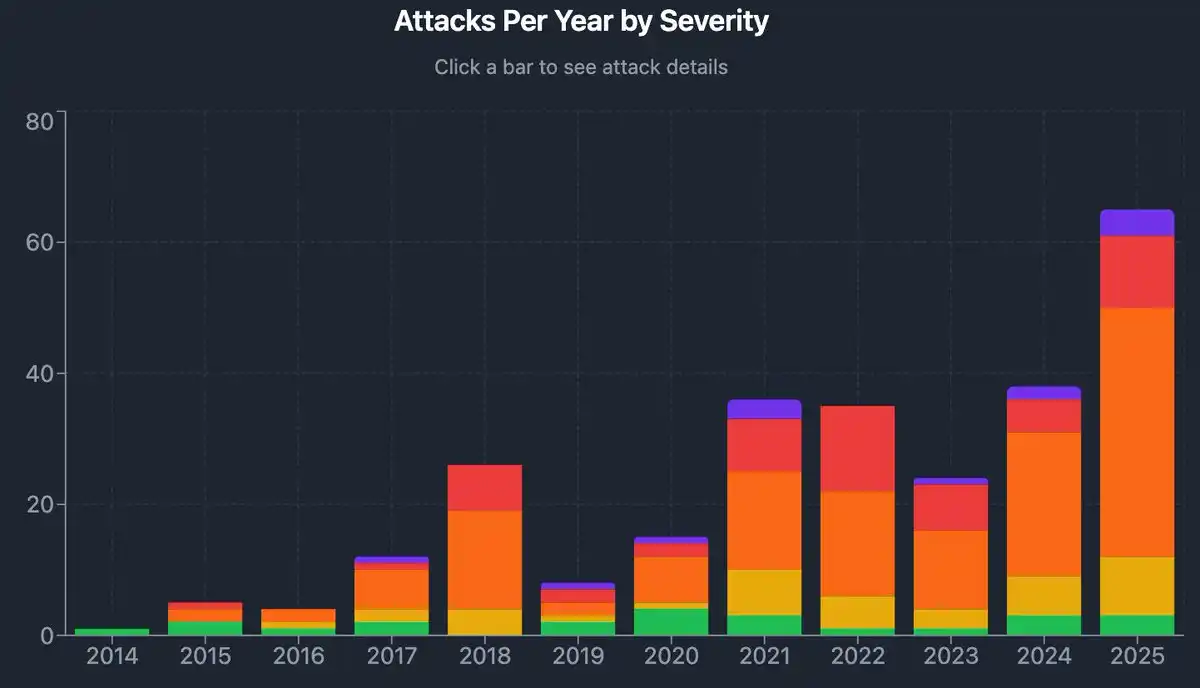
You are not mistaken—the number of attack incidents is indeed increasing over time (with 65 incidents in 2025). Furthermore, the attacks themselves are becoming more violent.
I had Claude categorize each attack into 5 levels, with the specific classification scheme as follows:
· Minor (3 incidents in 2025): Theft without physical confrontation, attempted theft, ATM/device theft.
· Moderate (9 incidents in 2025): Robbery with some level of violence or assault, drugging, extortion;
· Severe (38 incidents in 2025): Armed robbery, kidnapping, home invasion with firearms or weapons;
· Extremely Severe (11 incidents in 2025): Kidnapping involving torture, dismemberment, severe beating, gunshot wounds;
· Fatal (4 incidents in 2025): Victim fatality.
From the results, it can be seen that on average, the level of violence per single attack is continuously increasing.
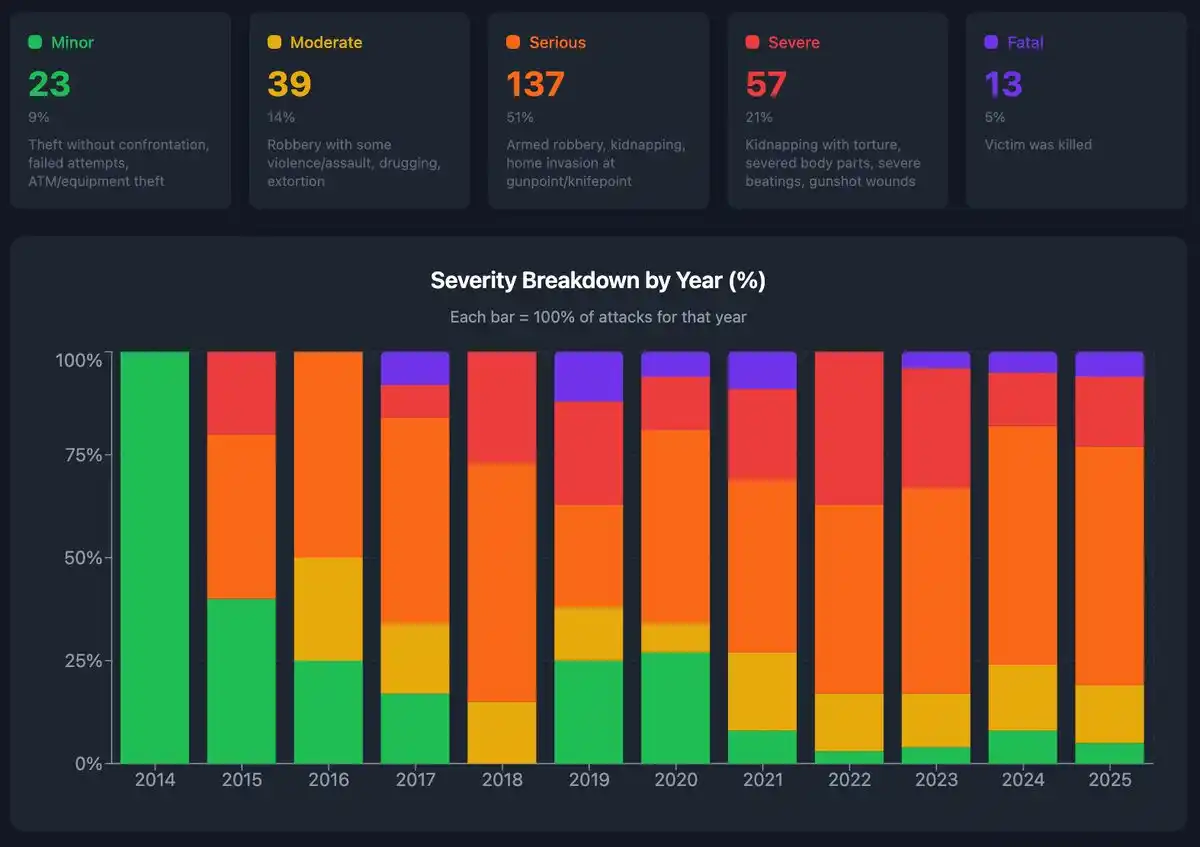
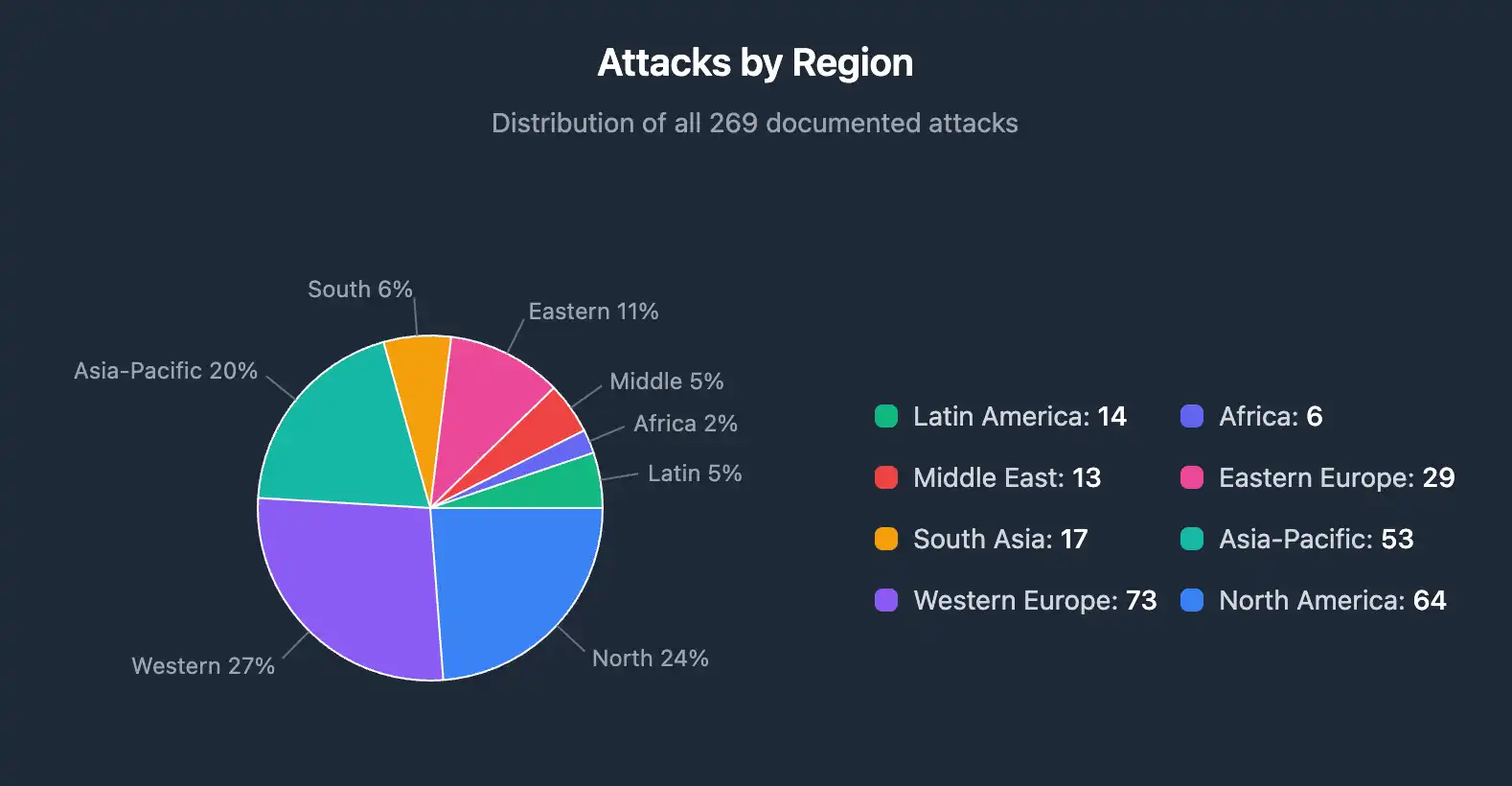
Geographically, Western Europe and the Asia-Pacific region saw the highest increase in violent incidents. North America is currently still relatively the safest region, but even in North America, there has been an upward trend in absolute numbers.
So, what is causing the rise in violent incidents?
One of the most straightforward explanations is to link the frequency of violent incidents to the total market capitalization of the cryptocurrency market. In simple terms—higher prices, more crime.
Take a look at the chart results: the white line represents the total market cap of cryptocurrency; the colored area represents the number of violent incidents.
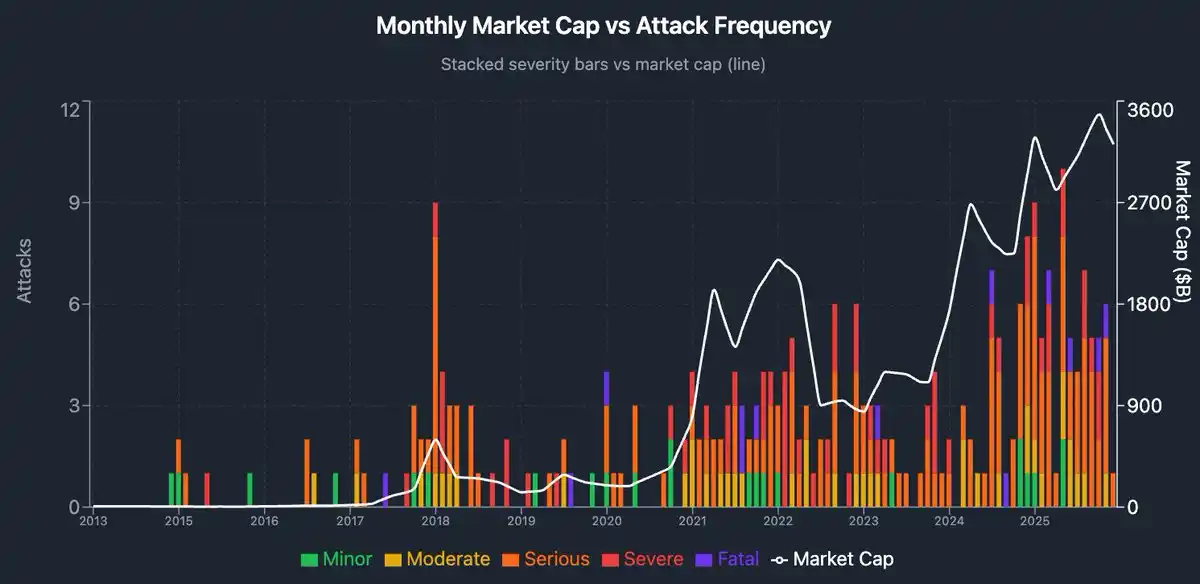
Conducting a simple regression analysis, the provided R² result is 0.45, meaning that 45% of the variation in violent incidents can be explained solely by the price itself. In other words, as we mentioned earlier, when prices rise, violent incidents increase—I have also run regression analyses on other variables, but none are as convincing as total market cap.
So, is it that simple? Does this already prove that holding cryptocurrency will pose an increasing personal danger?
We can perform another "stress test" to see if there are other hypotheses that could explain why the number of violent incidents is on the rise?
One possible explanation is that the increase in cryptocurrency prices inherently means more people hold cryptocurrency assets. In other words, the increase in criminal events may simply be because the "population base" has increased, and the actual risk of violence faced by each individual may not have truly risen.
Let's conduct a rationality check on this. Since accurately measuring the total number of cryptocurrency users is difficult, I chose two alternative indicators:
· The first is Coinbase's monthly active users, not cumulative registered users, as we want to exclude those who have already churned and no longer hold coins;
· The second method is more rudimentary, analyzing the number of violent incidents per unit market cap to derive an approximate measure of the "likelihood of theft per dollar."
Once you standardize the above data, you will see completely different conclusions: the blue line represents the number of violent incidents per Coinbase user; the green line represents the number of violent incidents per dollar of wealth
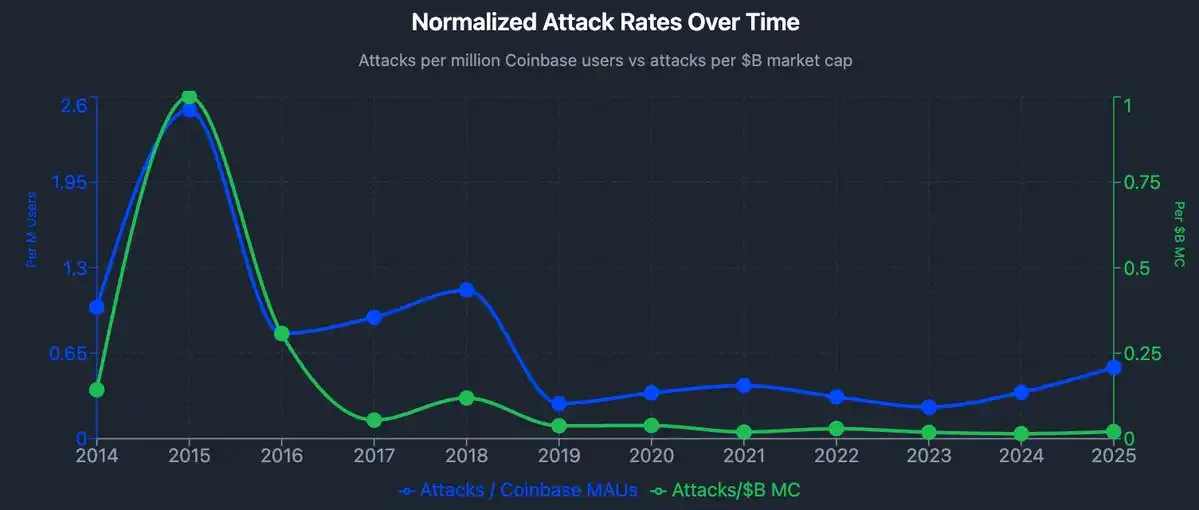
This data set suggests that 2015 and 2018 were actually the most dangerous periods to hold crypto. Yes, even though the number of attack incidents was much lower at that time, the number of cryptocurrency holders was also much, much lower.
From 2015 to 2025, Coinbase's monthly active users grew from 2 million to 120 million, a whopping 60x increase, but violent incidents did not increase proportionally.
Certainly, in recent years, the number of violent incidents per user has indeed increased, but the increase has been relatively modest, roughly equivalent to the 2021 violence levels and significantly lower than pre-2019 levels. Meanwhile, the rate of violent incidents per dollar of wealth has remained nearly unchanged.
We must also consider the alternative hypothesis of "news reporting bias"—whether incidents are just more likely to be reported—but this is beyond the scope of this analysis.
Overall, the number of violent incidents is indeed increasing, and the attack methods are becoming more violent. However, this can be partially attributed to the "population effect," meaning there are now more cryptocurrency holders, so the individual risk is not increasing as dramatically as it may seem.
But ultimately, this is not just an academic discussion. This is a truly serious, real-world issue.
If you are part of a high-risk group, there are actually many ways to improve your personal security. Here are some standard offline security suggestions:
· Try to live in a secure city, preferably in a residence with 24/7 security;
· Avoid wearing cryptocurrency-related clothing or implying that you hold cryptocurrency in public;
· Use a service like DeleteMe to remove your personal information from data brokers;
· Get a PO Box and have all commercial mail sent there to prevent your address from being widely circulated;
· Set up a hot wallet with a "giveaway" amount of money that is entirely separate from your actual cold storage assets;
· Diversify your funds: use multiple services, platforms, and devices to store your assets so that you don't lose everything at once in the worst-case scenario;
· Unless necessary, avoid publicly broadcasting your specific location in real-time, especially during cryptocurrency conferences;
· If you are truly part of a high-risk group or are about to visit a high-risk area, consider hiring private security – in some areas, this can be much more useful than you think.
2026 has arrived, and the year-end is approaching, with a long holiday ahead. Please be sure to stay safe.
You may also like

After two years, Hong Kong's first batch of stablecoin licenses finally issued: HSBC, Standard Chartered make the cut

The person who helped TAO rise by 90% has now single-handedly crashed the price again today

3-Minute Guide to Participating in the SpaceX IPO on Bitget

Top 5 Cryptos to Buy in 2026 Q1: A ChatGPT Deep Dive Analysis
Explore the top 5 cryptos to buy in Q1 2026 including BTC, ETH, SOL, TAO, and ONDO. See price outlooks, key narratives, and institutional catalysts shaping the next market move.

How to Earn $15,000 with Idle USDT Before Altcoin Season 2026
Wondering if altcoin season is coming in 2026? Get the latest market update, and learn how to turn your idle stablecoins waiting for entry into extra rewards up to 15,000 USDT.
Can You Win Joker Returns Without Large Trading Volume? 5 Mistakes New Players Make In WEEX Joker Returns Season 2
Can small traders win WEEX Joker Returns 2026 without huge volume? Yes—if you avoid these 5 costly mistakes. Learn how to maximize card draws, use Jokers wisely, and turn small deposits into 15,000 USDT rewards.

Altcoin Season 2026: 4 Stages to Profit (Before the Crowd FOMO In)
Altcoin Season 2026 is starting — discover the 4 key stages of capital rotation (from ETH to PEPE) and how to position before the peak. Learn which tokens will lead each phase and avoid missing the rally.

Will Alt season come in 2026? 5 Tips to Spot the Next 100x Crypto Opportunities
Will altcoin season arrive in 2026? Discover 5 rotation stages, early signals smart traders watch, and the key crypto sectors where the next 100x altcoin opportunities may emerge.

The bear market has arrived, and cryptocurrency ETF issuers are also getting involved

The richest man had a quarrel with his former boss

BTC Firm Above 70K! Saylor’s "Institutional Logic" vs. Moon’s "Retail Faith": Who is Really Harvesting the Market?
Bitcoin is holding firm above the $70,000 support level following a massive short squeeze that liquidated $427 million. As the "Four-Year Cycle" narrative shifts, the market is split: Michael Saylor’s cold, institutional "indiscriminate stacking" vs. Carl Moon’s high-energy retail "hopium." This article decodes these two polar-opposite strategies for the 2026 bull run and reveals how WEEX’s institutional-grade liquidity and AI trading tools empower every type of investor to convert market volatility into profit.

The Girl Who Created the SBTI Test: A Story of a Doomed Cyber Love, an E-Widow Ratfolk

B.AI Officially Launched: Building AI Agent Financial Bedrock Platform, Driving AGI Era Business Underlying Logic

B.AI Officially Launched: Breaking Down A2A Collaboration Barriers to Unlock the Smart Body Economy's Full Potential
We helped Xu Mingxing write a book called "<OK Life>".

Rare APY of 400%, is TradeXYZ handing out money to oil bulls?
a16z: Perpetual Contracts are Rewriting Global Trading Rules

Bitcoin Hits $73,000 Triggering $427M Short Liquidation | Carl Moon: $200,000 is the Target
April 9, 2026 (UTC+0), 22:17. Bitcoin (BTC) executed a high-velocity surge within minutes, heavy-hitting the $73,000 psychological barrier and touching a local high near $74,000. While the price has since retraced to consolidate above $72,000, this "instant ambush" successfully completed a $427M liquidation of short positions.
After two years, Hong Kong's first batch of stablecoin licenses finally issued: HSBC, Standard Chartered make the cut
The person who helped TAO rise by 90% has now single-handedly crashed the price again today
3-Minute Guide to Participating in the SpaceX IPO on Bitget
Top 5 Cryptos to Buy in 2026 Q1: A ChatGPT Deep Dive Analysis
Explore the top 5 cryptos to buy in Q1 2026 including BTC, ETH, SOL, TAO, and ONDO. See price outlooks, key narratives, and institutional catalysts shaping the next market move.
How to Earn $15,000 with Idle USDT Before Altcoin Season 2026
Wondering if altcoin season is coming in 2026? Get the latest market update, and learn how to turn your idle stablecoins waiting for entry into extra rewards up to 15,000 USDT.
Can You Win Joker Returns Without Large Trading Volume? 5 Mistakes New Players Make In WEEX Joker Returns Season 2
Can small traders win WEEX Joker Returns 2026 without huge volume? Yes—if you avoid these 5 costly mistakes. Learn how to maximize card draws, use Jokers wisely, and turn small deposits into 15,000 USDT rewards.


 App
App